


1 Overview
Enhance WooCommerce registration with custom fields using a simple drag-and-drop builder.
The Registration Field Suite Lite allows you to extend the capabilities of the default WooCommerce registration form. It offers a visual, drag-and-drop builder for adding custom fields, making it simpler to gather essential information from your customers during the sign-up process. This plugin is specifically designed for WooCommerce integrations, ensuring that all user data is seamlessly saved as user meta in your store's database.
This lite version is perfect for stores needing a straightforward approach to collecting additional information at registration. While maintaining compatibility with WooCommerce and implementing per-field validation, the plugin remains lightweight and user-friendly, avoiding unnecessary complexities. Start optimizing your customer registration processes with Registration Field Suite Lite today.
At a Glance
- Drag-and-drop form builder
- 9 field types supported
- Seamless WooCommerce integration
- Per-field data validation
- Customizable section labels
- Lightweight design with no AI
- HPOS compatibility
- Free to use
| Plugin | Registration Field Suite Lite |
|---|---|
| Version | 1.0.0 |
| Author | RegistrationFieldSuite |
| License | GPL-2.0+ |
| WooCommerce | Compatible |
| Files | 83 total (41 PHP) |
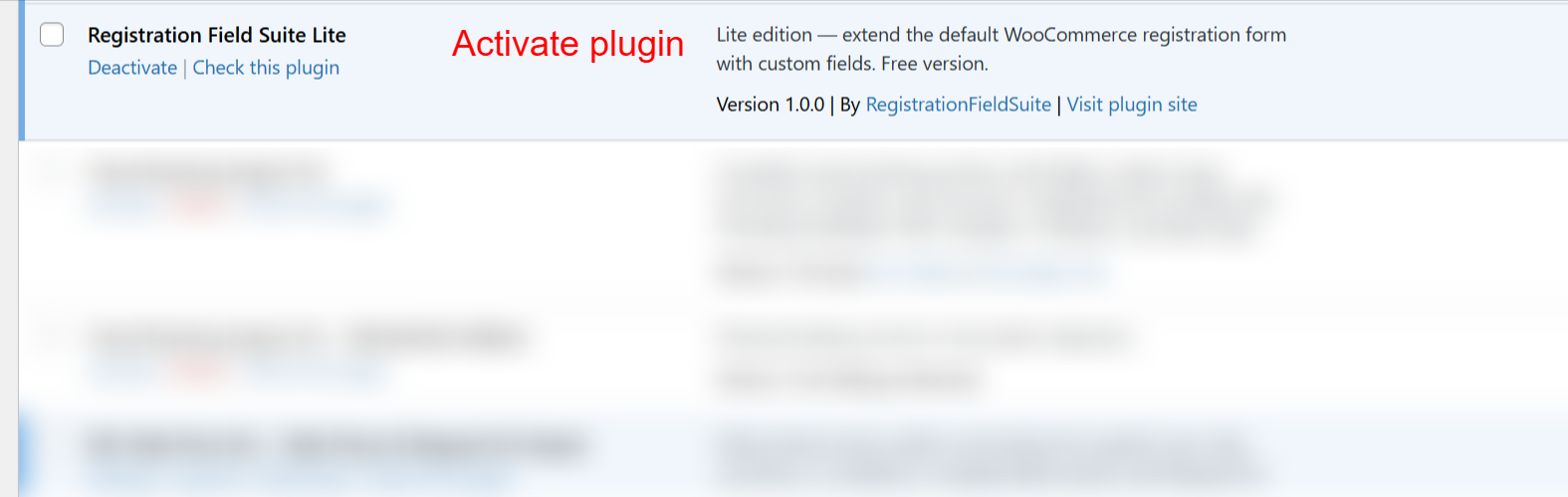
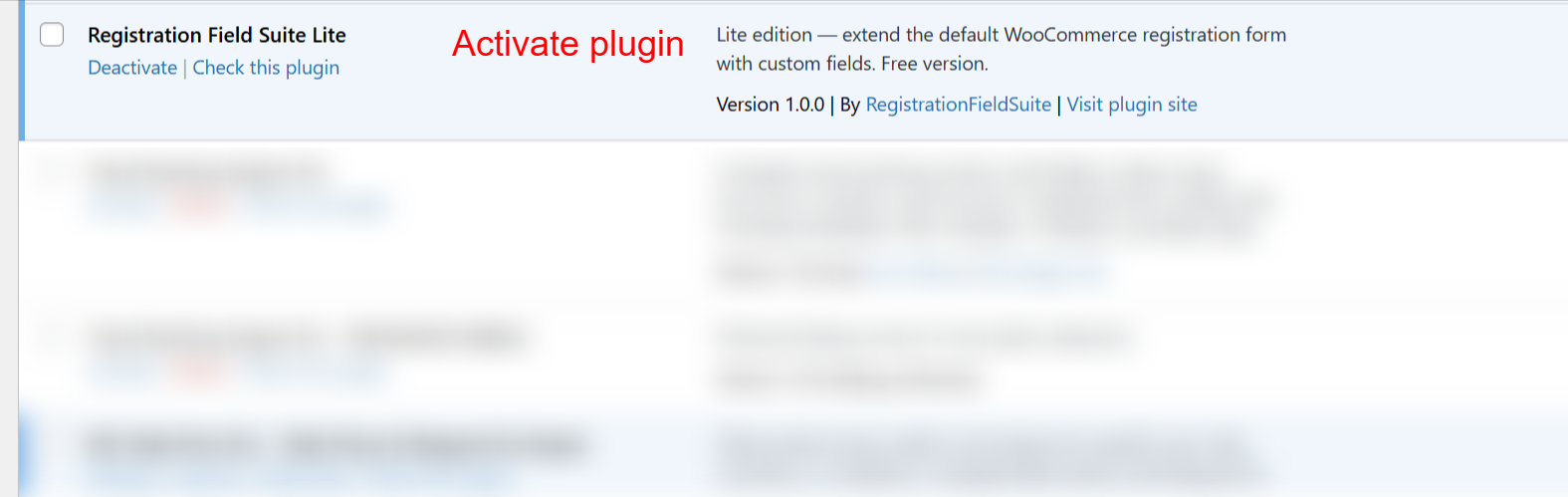
On this screen, you can activate the Registration Field Suite Lite plugin, which is essential for extending the functionality of WooCommerce registration forms. Activating the plugin enables you to add custom fields to the default WooCommerce registration form without needing additional customization.
2 Features
Drag-and-drop form arrangement
Custom section labels
Grid layout options (1-6 columns)
Multiple field types: Text, Checkbox, etc.
User meta data storage
Extensive field types selection
Per-field mandatory settings
Custom validation rules
Predefined values and default settings
Field arrangements and styling
Single form focus for ease
Settings for enabling/disabling fields
Confirmation on saved changes
User list management
Admin dashboard adjustments
Store user meta data securely
Reflect registration inputs in user list
Overview of saved user fields
Editable custom user fields
Tools for user data auditing
Form Customization
Easily tailor your registration forms using intuitive tools.
- Drag-and-drop form arrangement
- Custom section labels
- Grid layout options (1-6 columns)
- Multiple field types: Text, Checkbox, etc.
- User meta data storage
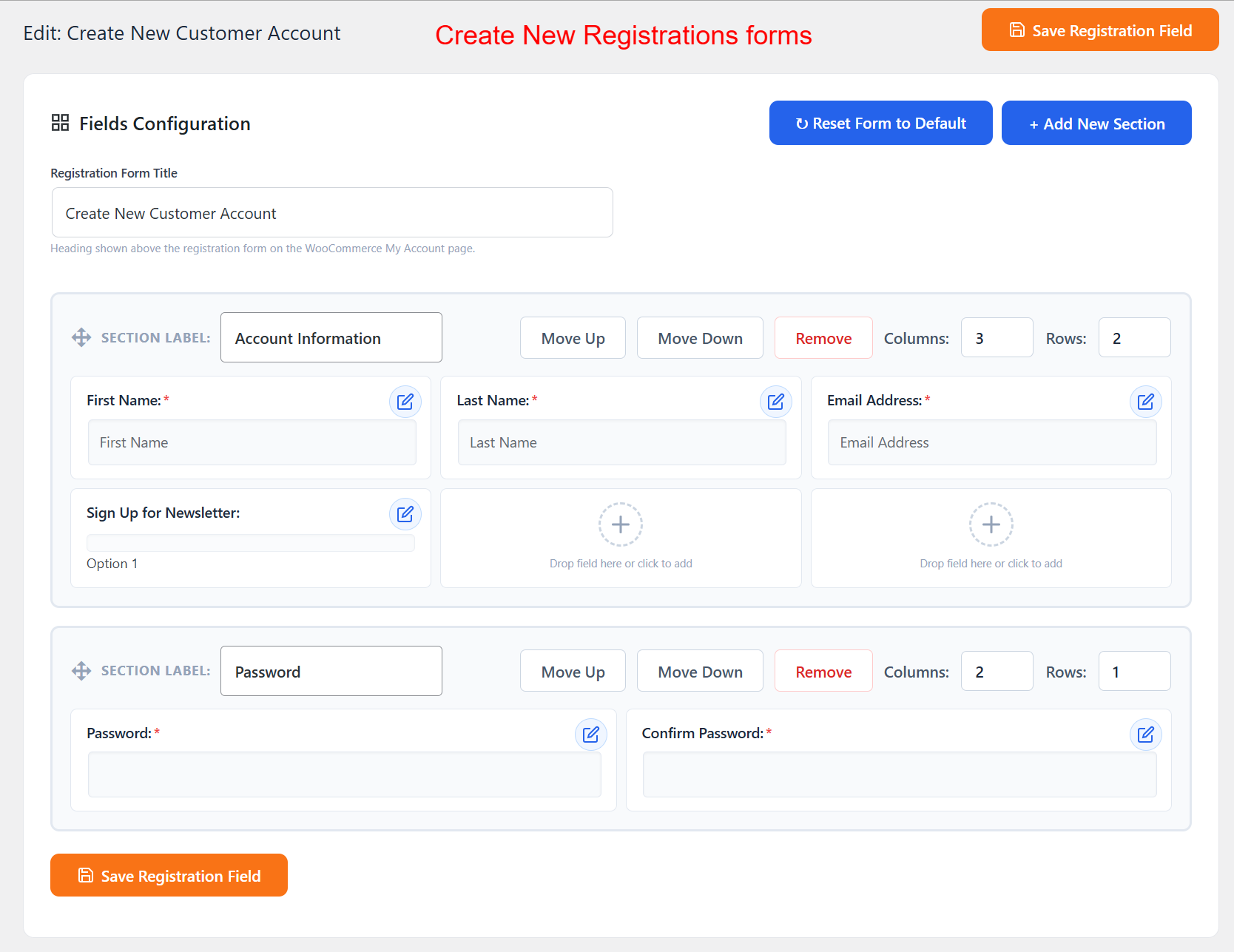
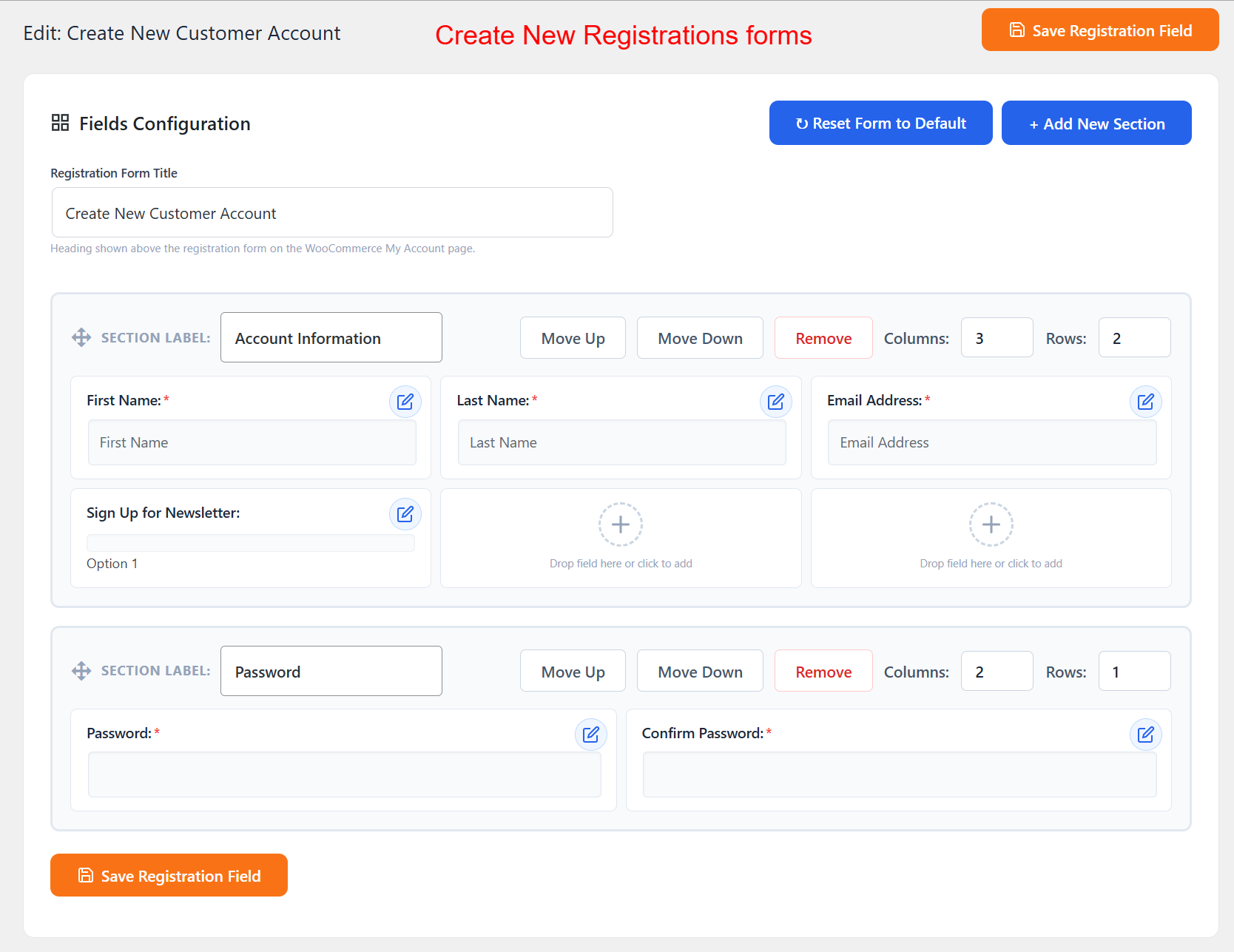
This screen is where you can design and customize the registration forms for your WooCommerce store. You can add new fields, arrange them in sections, and define how they display to users on the registration page, making it easier to collect necessary customer information.
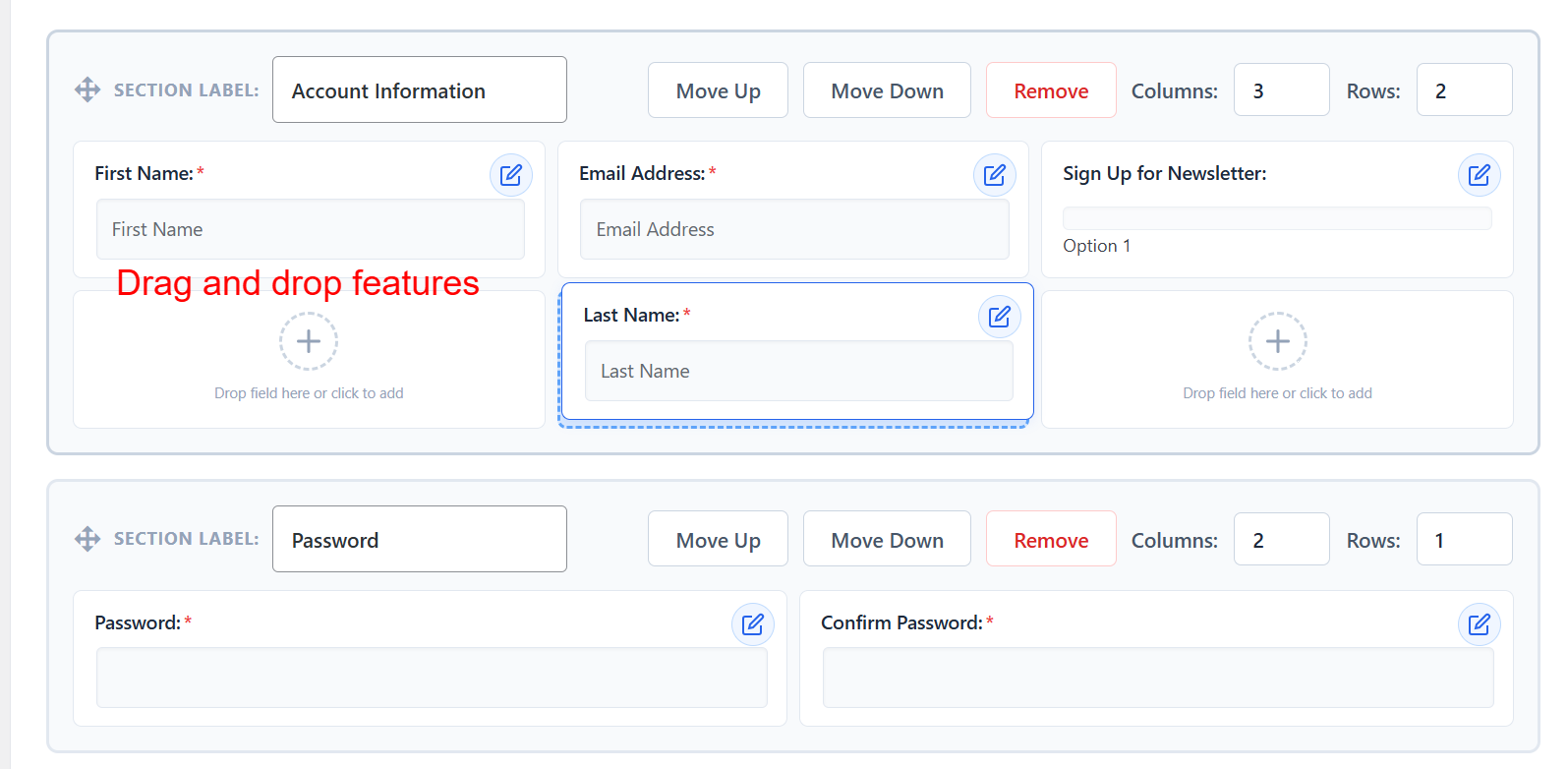
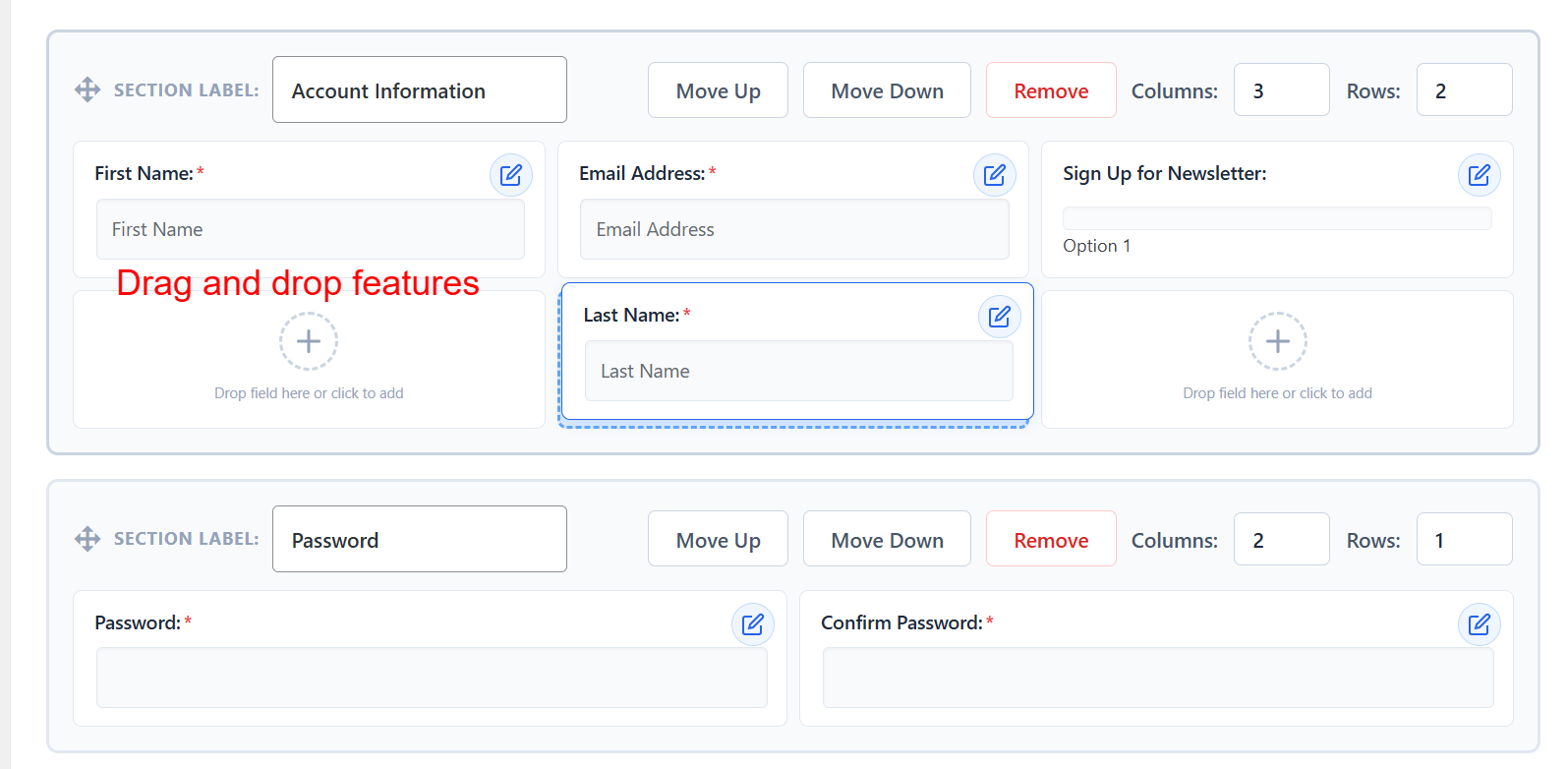
In this configuration screen, you can customize the WooCommerce registration form by dragging and dropping fields within sections. Each section features controls to move or delete fields, making it easy to tailor the form to your specific needs.
Advanced Field Options
Enhance data collection with versatile field configurations.
- Extensive field types selection
- Per-field mandatory settings
- Custom validation rules
- Predefined values and default settings
- Field arrangements and styling
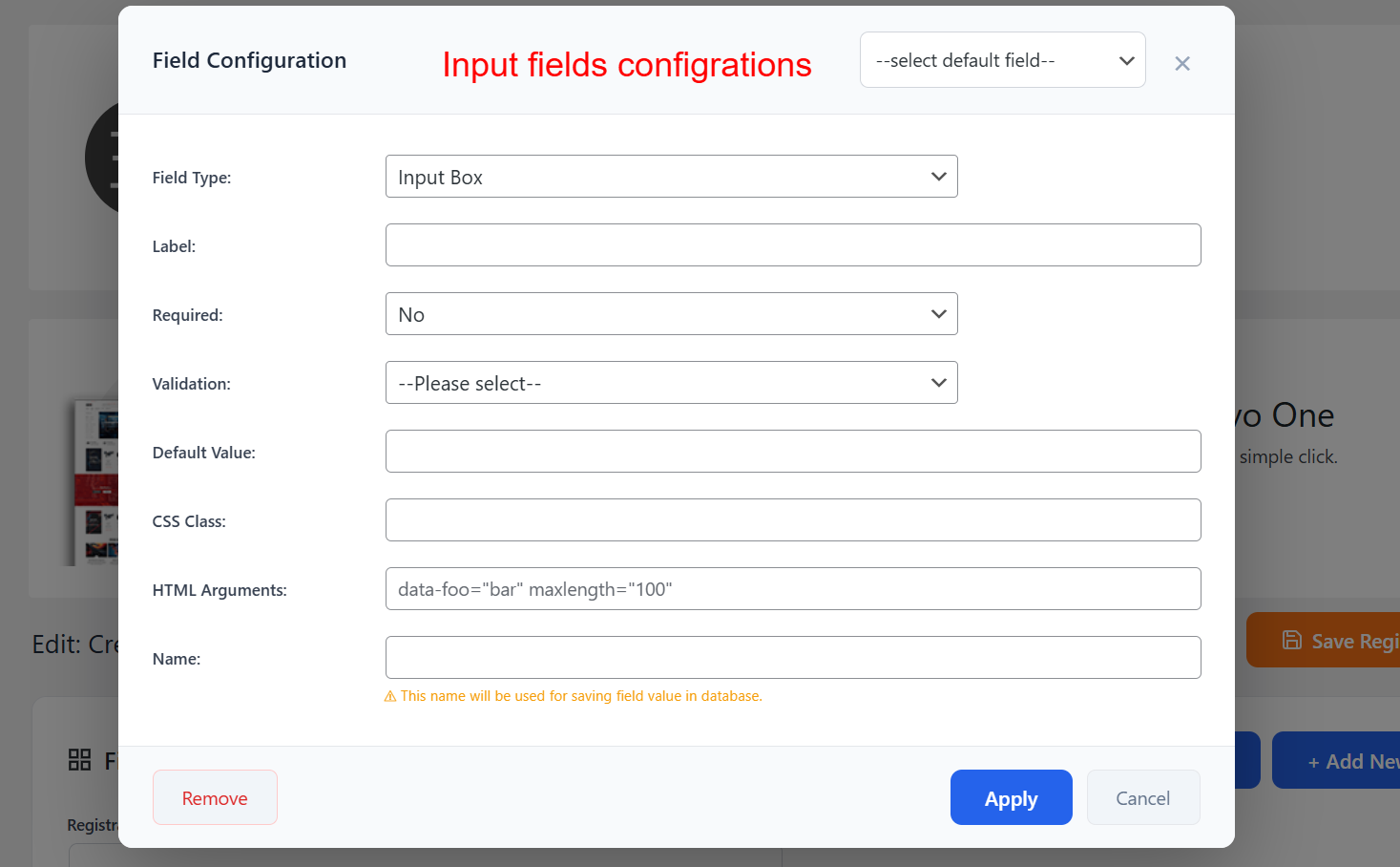
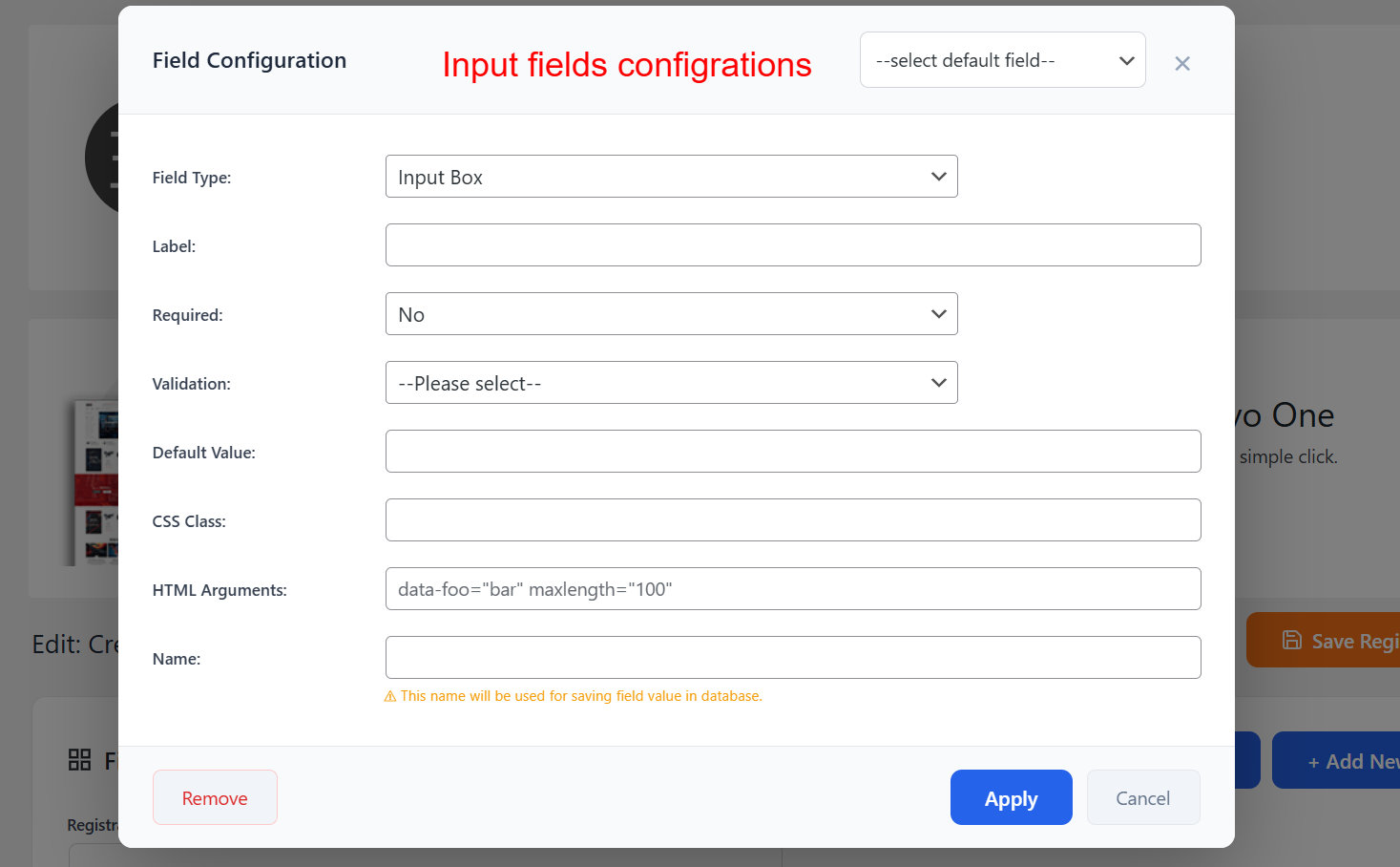
Within the field configuration modal, you can fine-tune the details of each custom field you add to your registration form. Define whether a field is mandatory, its input type, validation rules, and additional HTML for enhanced design and functionality.
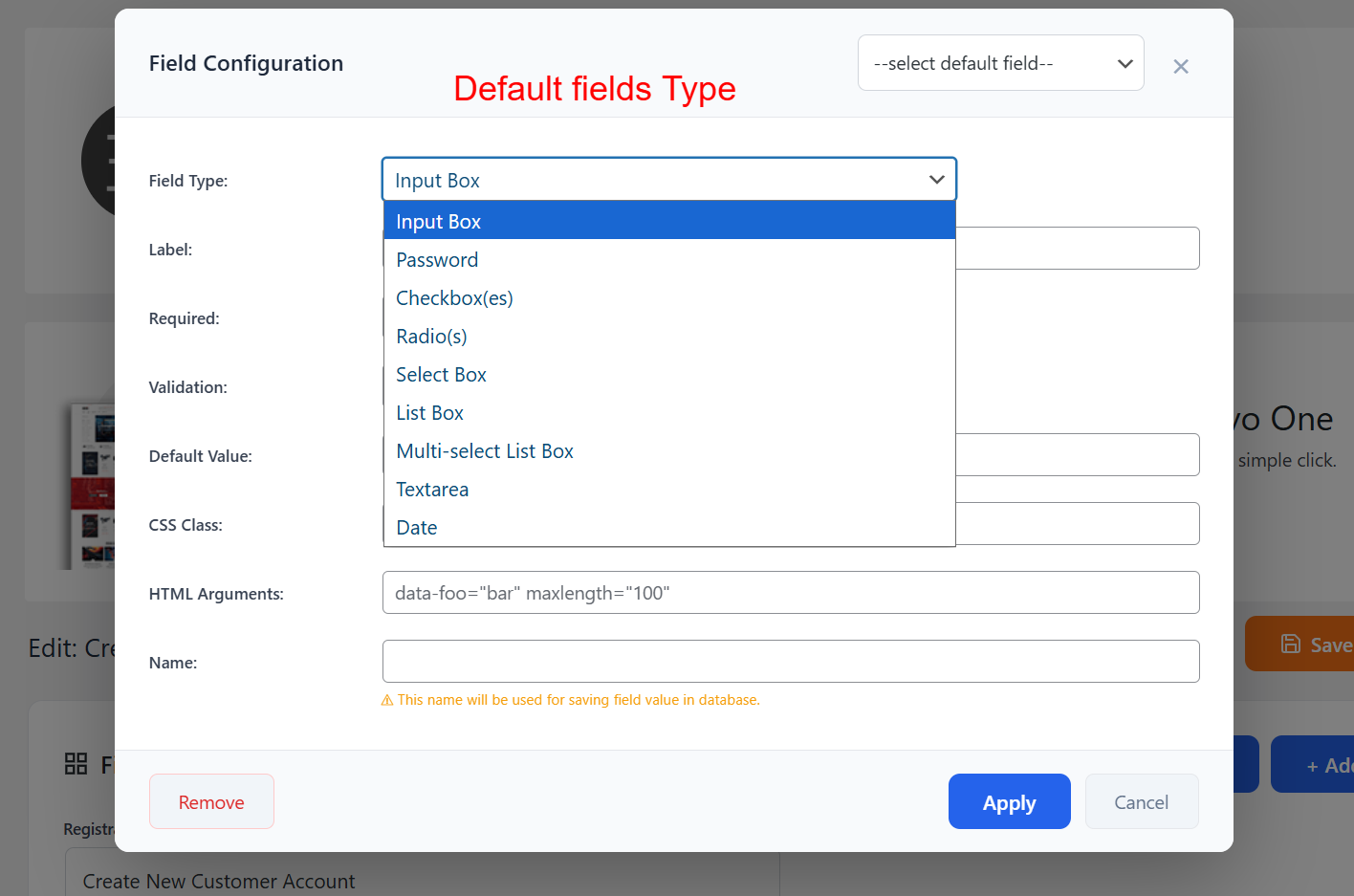
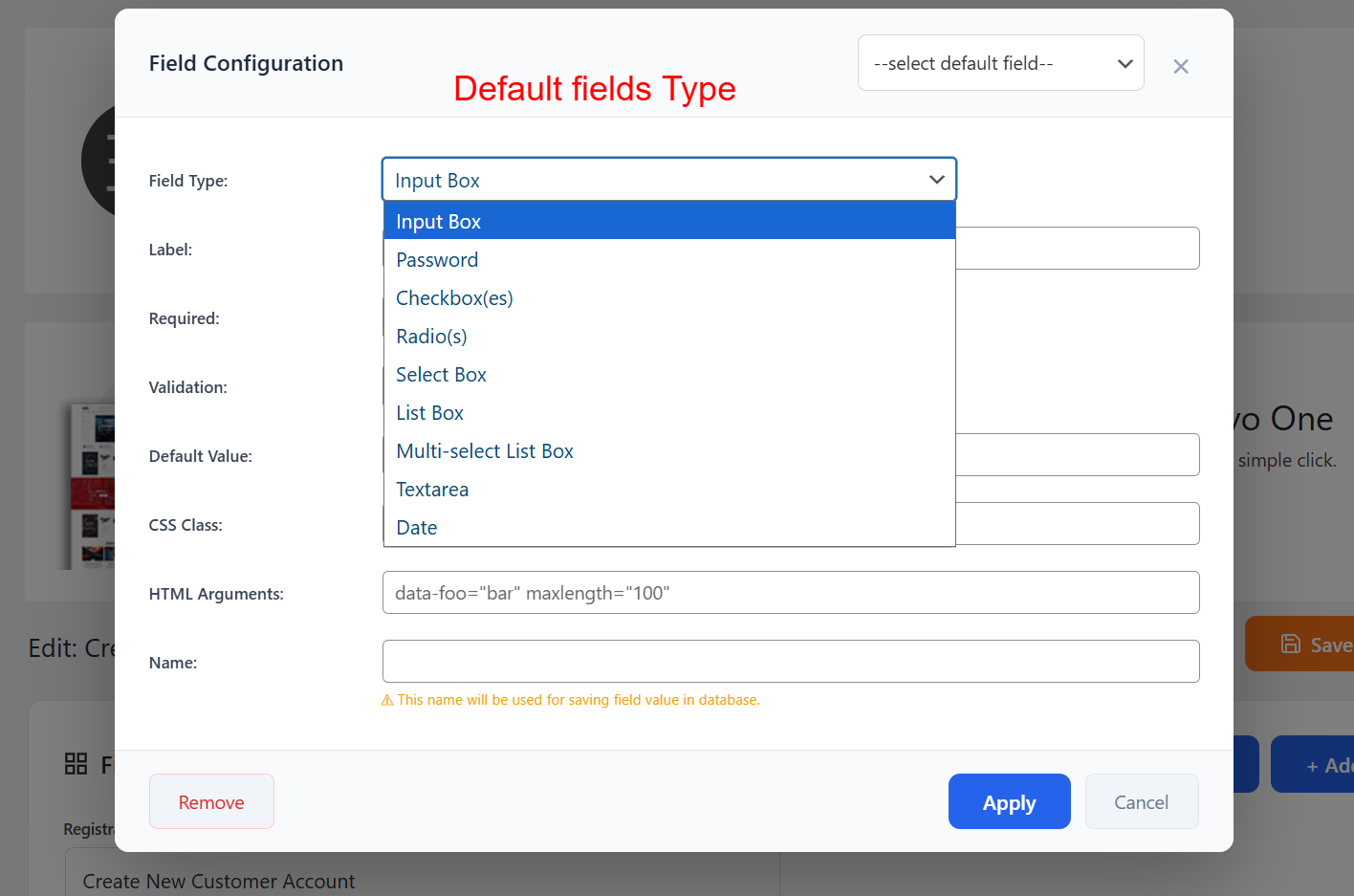
On this screen, select the type of input field you want to add to your registration form. Options include input boxes, checkboxes, radio buttons, and more, allowing you to gather specific data types from registrants.
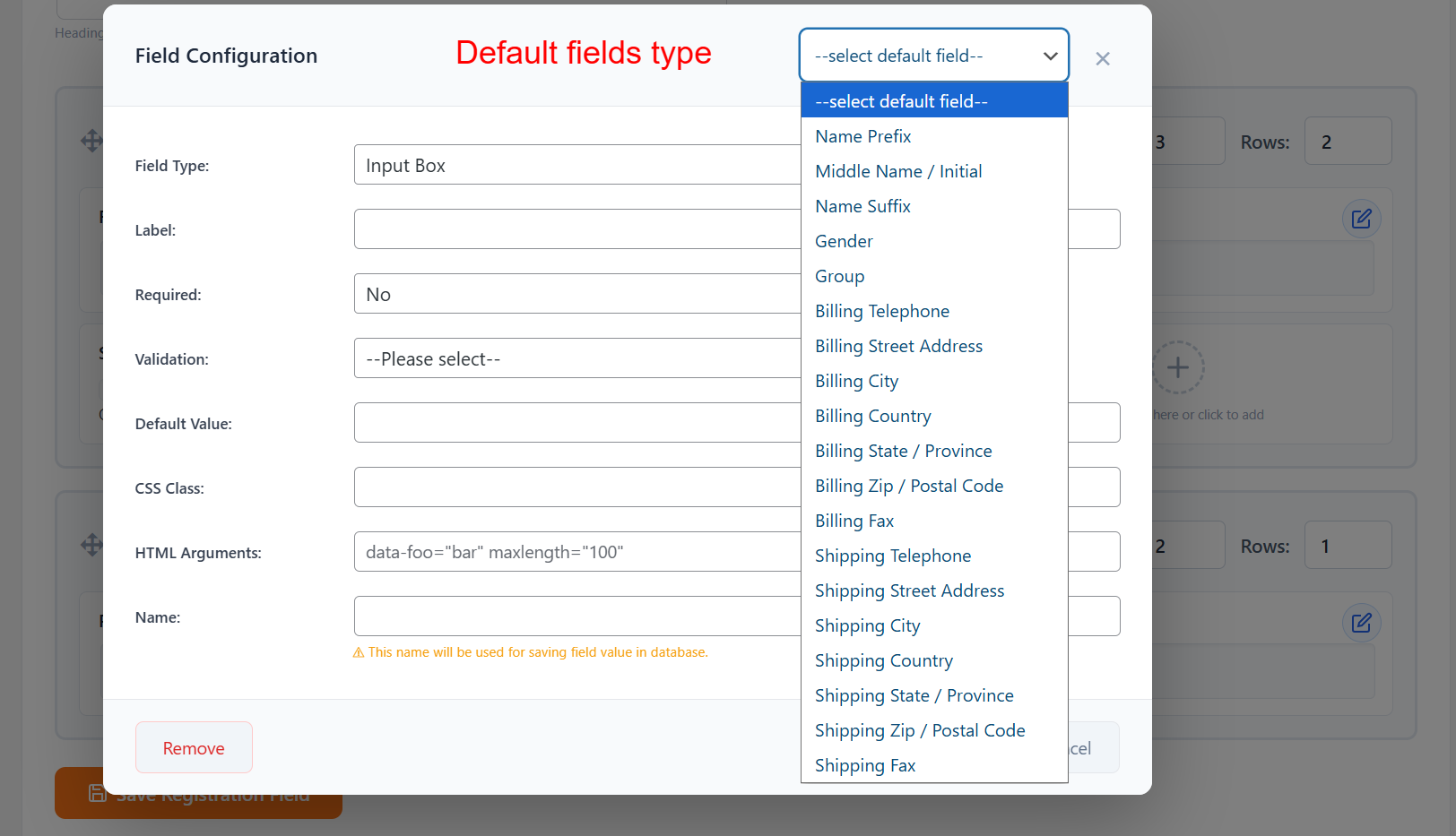
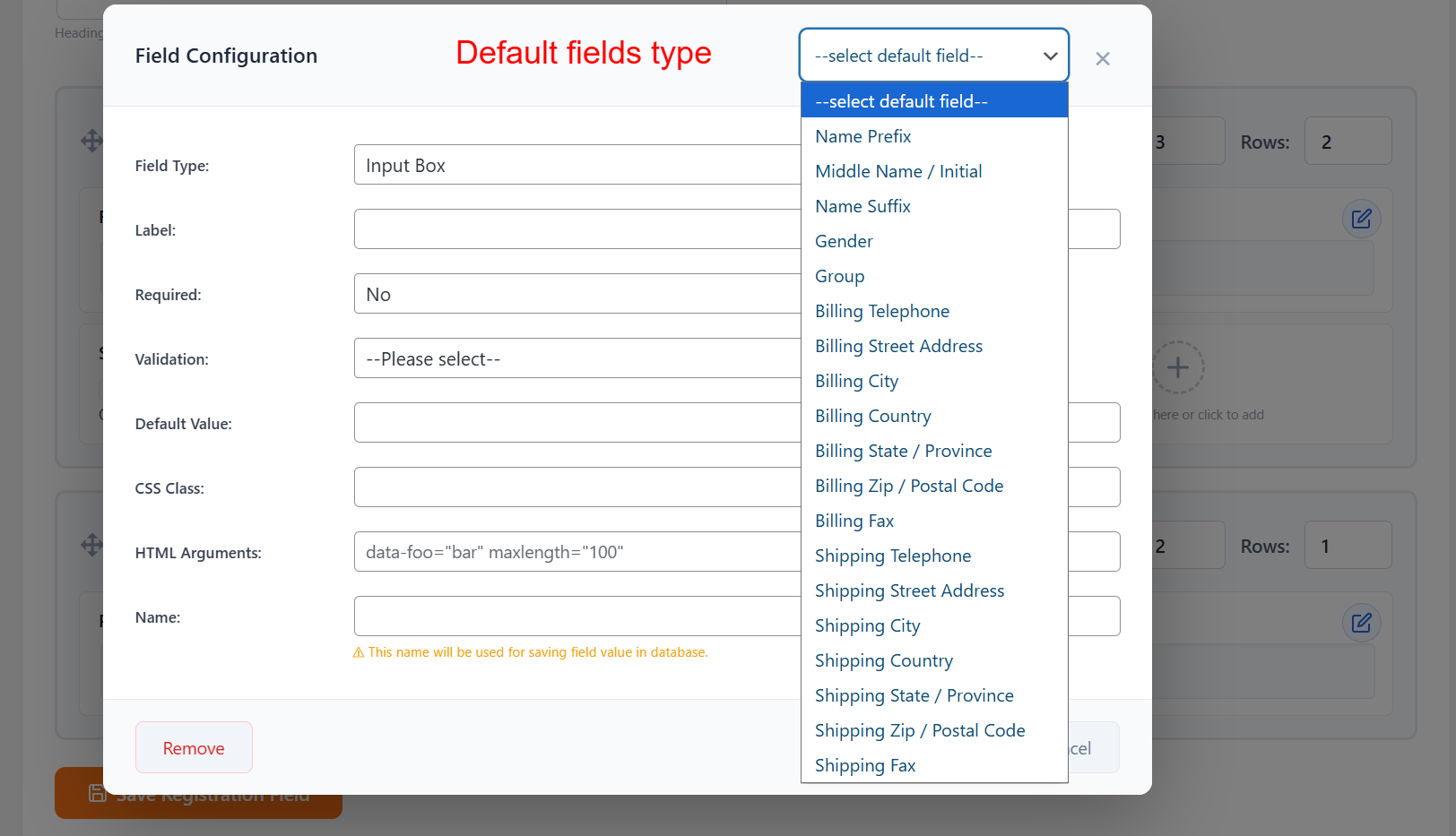
Here, choose from a list of default fields related to customer details, such as Name Prefix or Billing Information. This makes setting up comprehensive registration forms quick and straightforward.
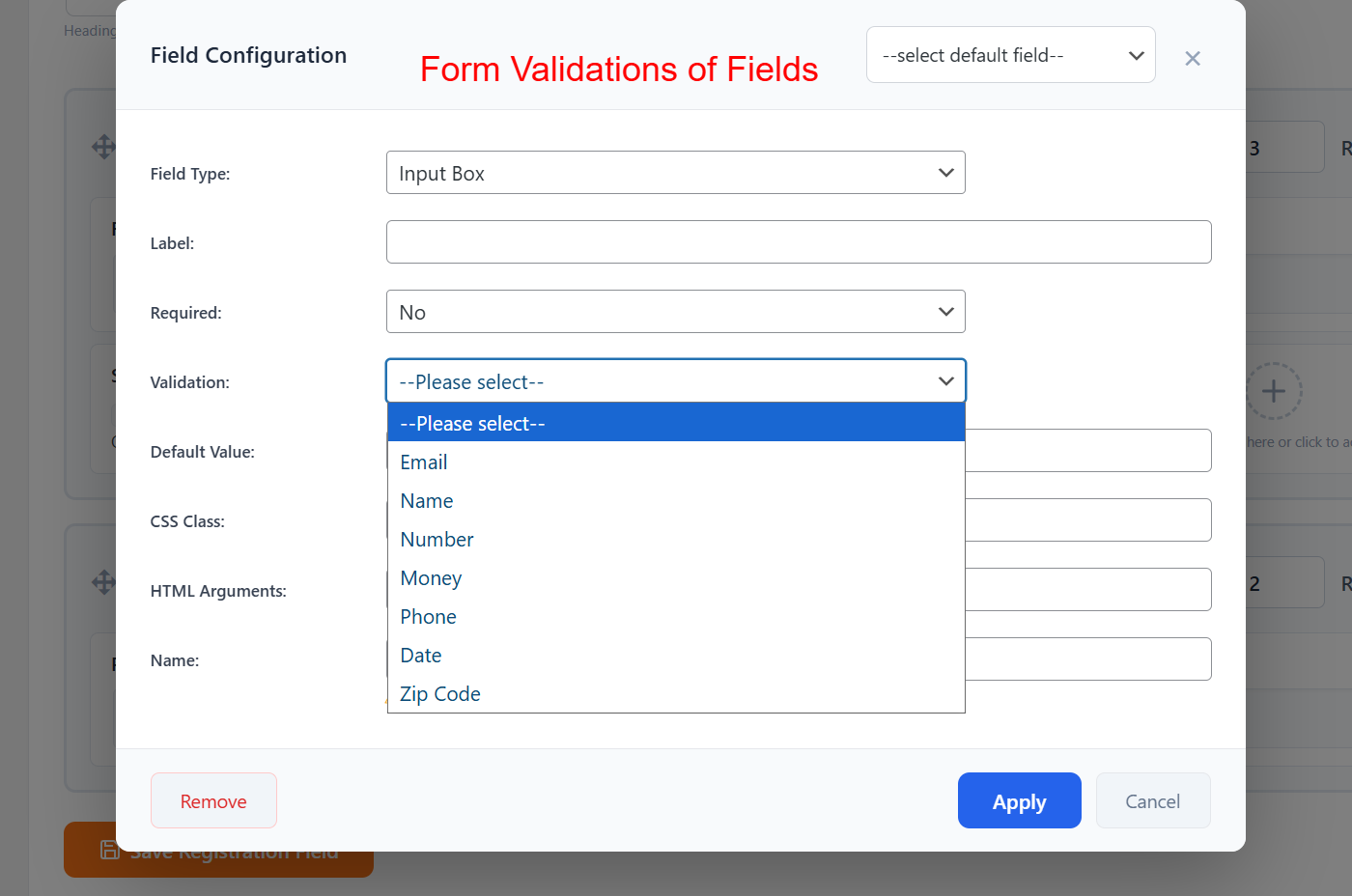
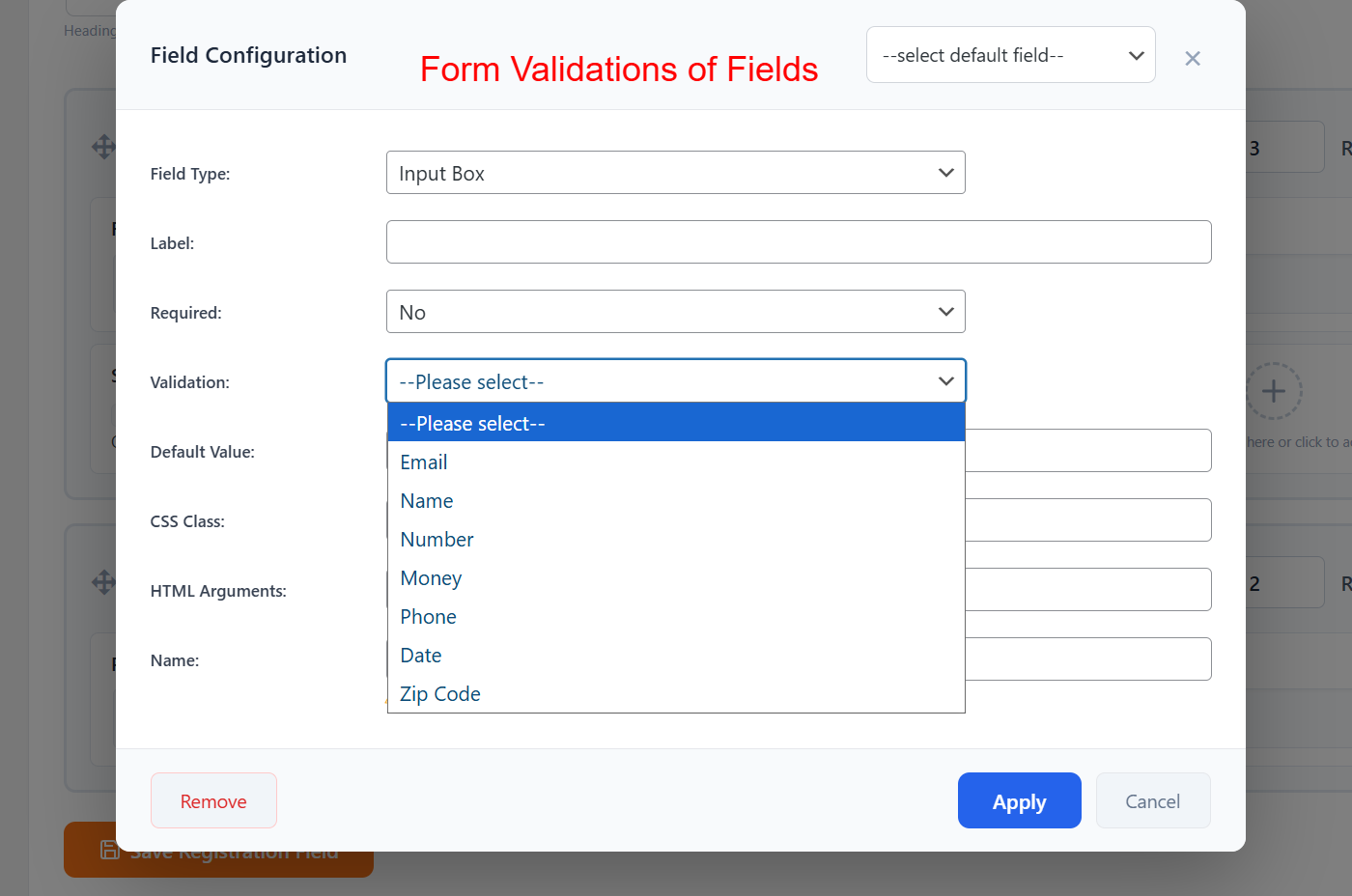
This part of the configuration allows you to apply validation rules to your form fields, ensuring that the data entered by users complies with specific criteria, such as format or type, enhancing form reliability and data accuracy.
Configuration and Administration
Manage and configure your registration form setup efficiently.
- Single form focus for ease
- Settings for enabling/disabling fields
- Confirmation on saved changes
- User list management
- Admin dashboard adjustments
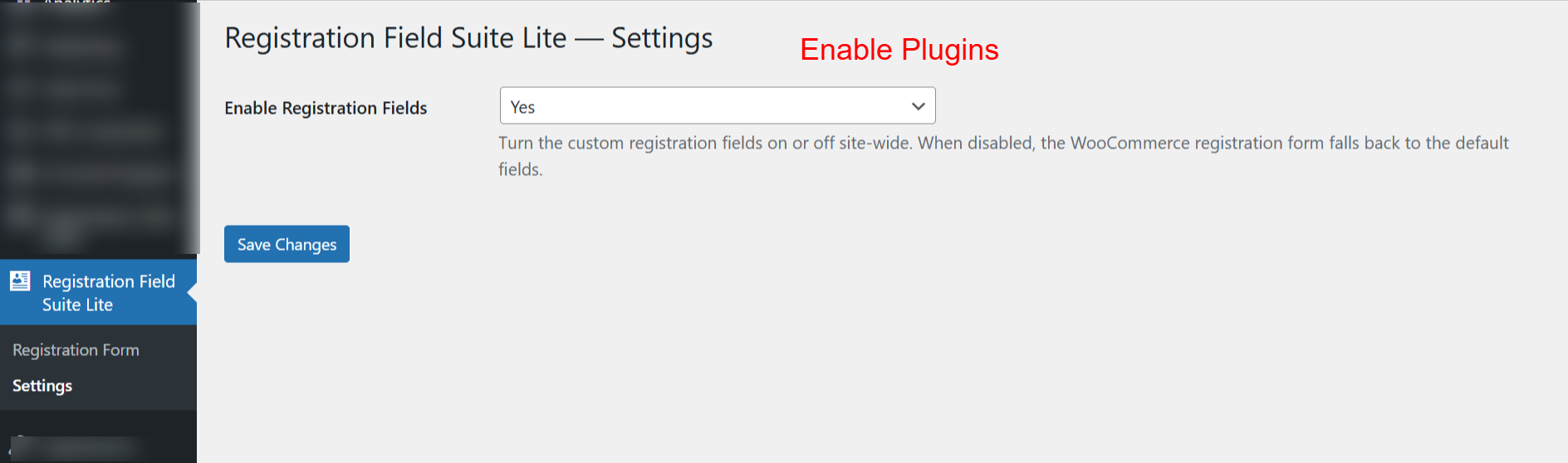
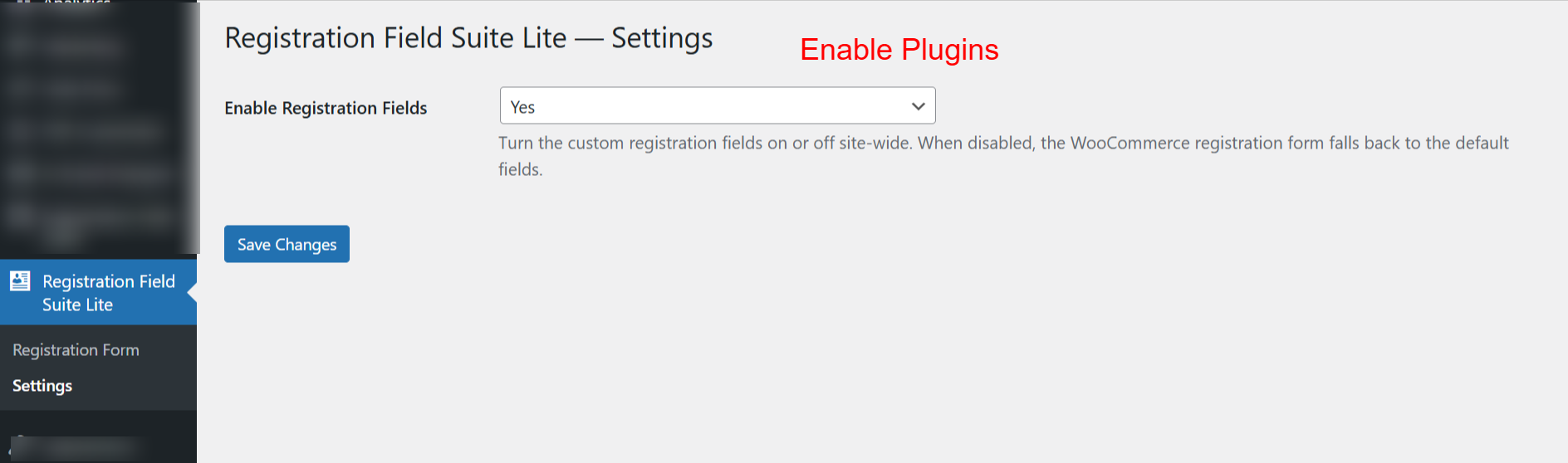
This settings page allows you to enable or disable the Registration Field Suite Lite plugin's custom fields across your site. Choosing 'Yes' ensures that the custom fields are visible and functional on your WooCommerce registration forms.
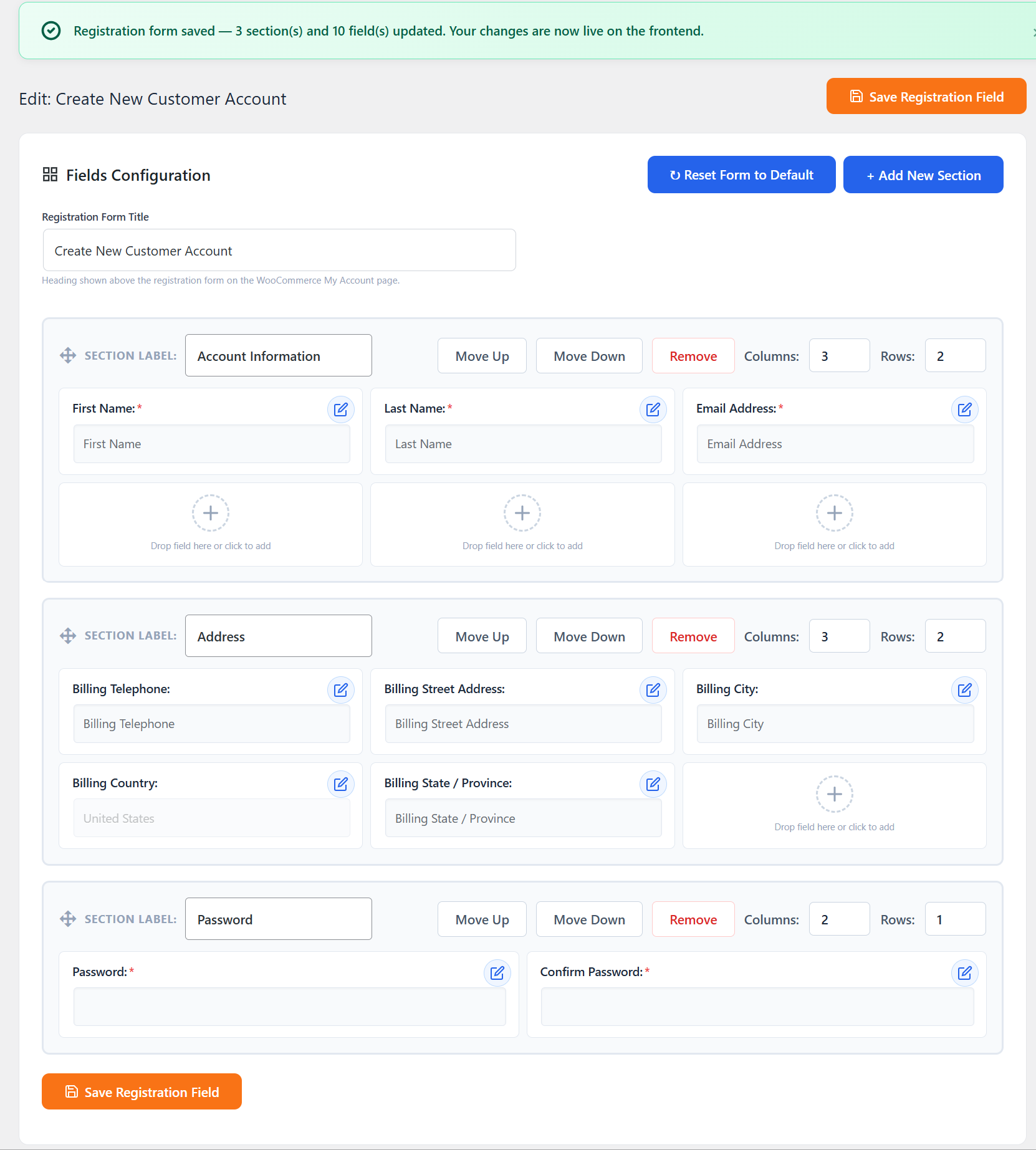
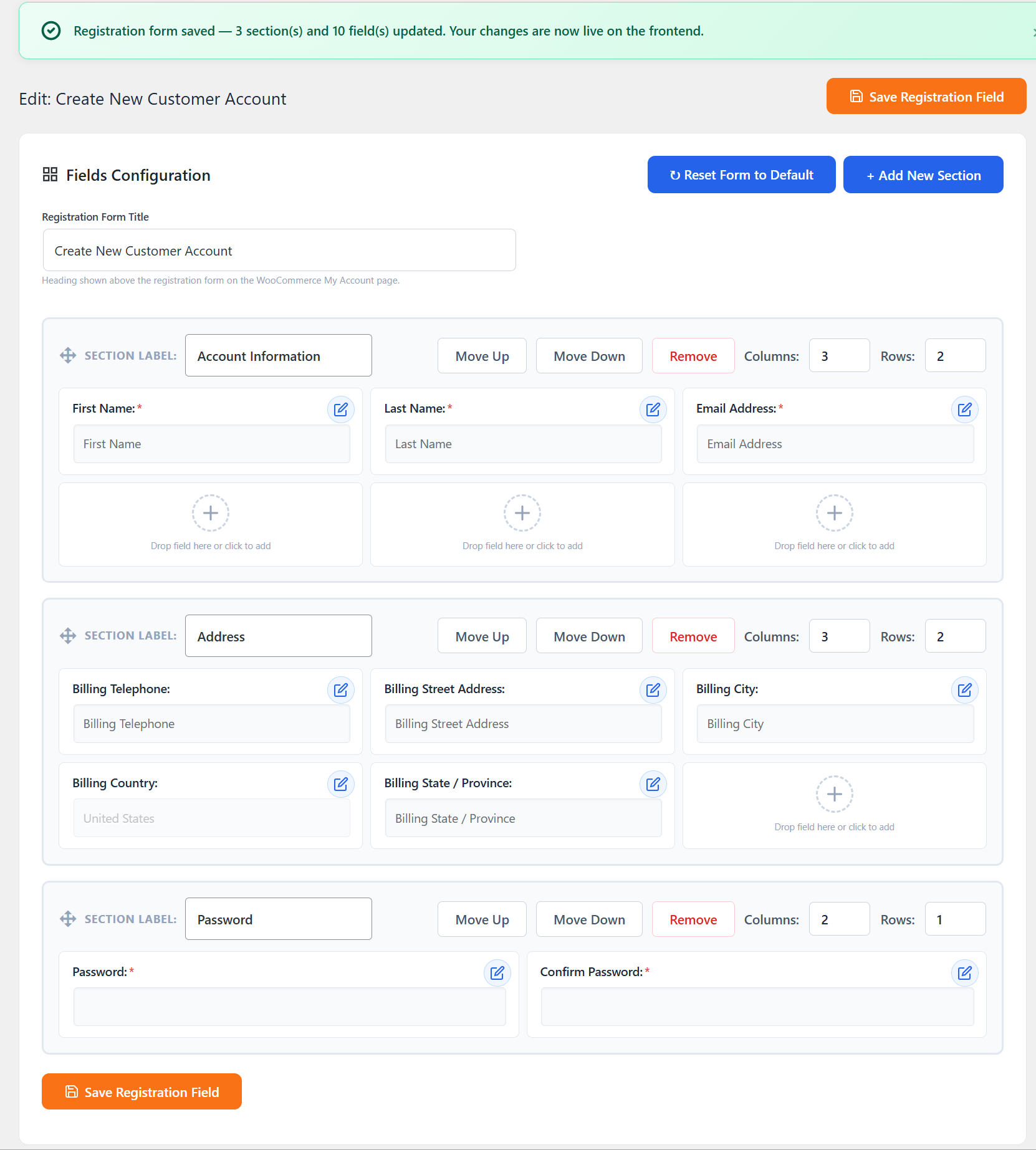
This screen confirms that the changes made to the registration form have been saved and are live on the frontend. It shows the entire form structure, including newly added sections and edited fields, ensuring users have full control over the form's layout.
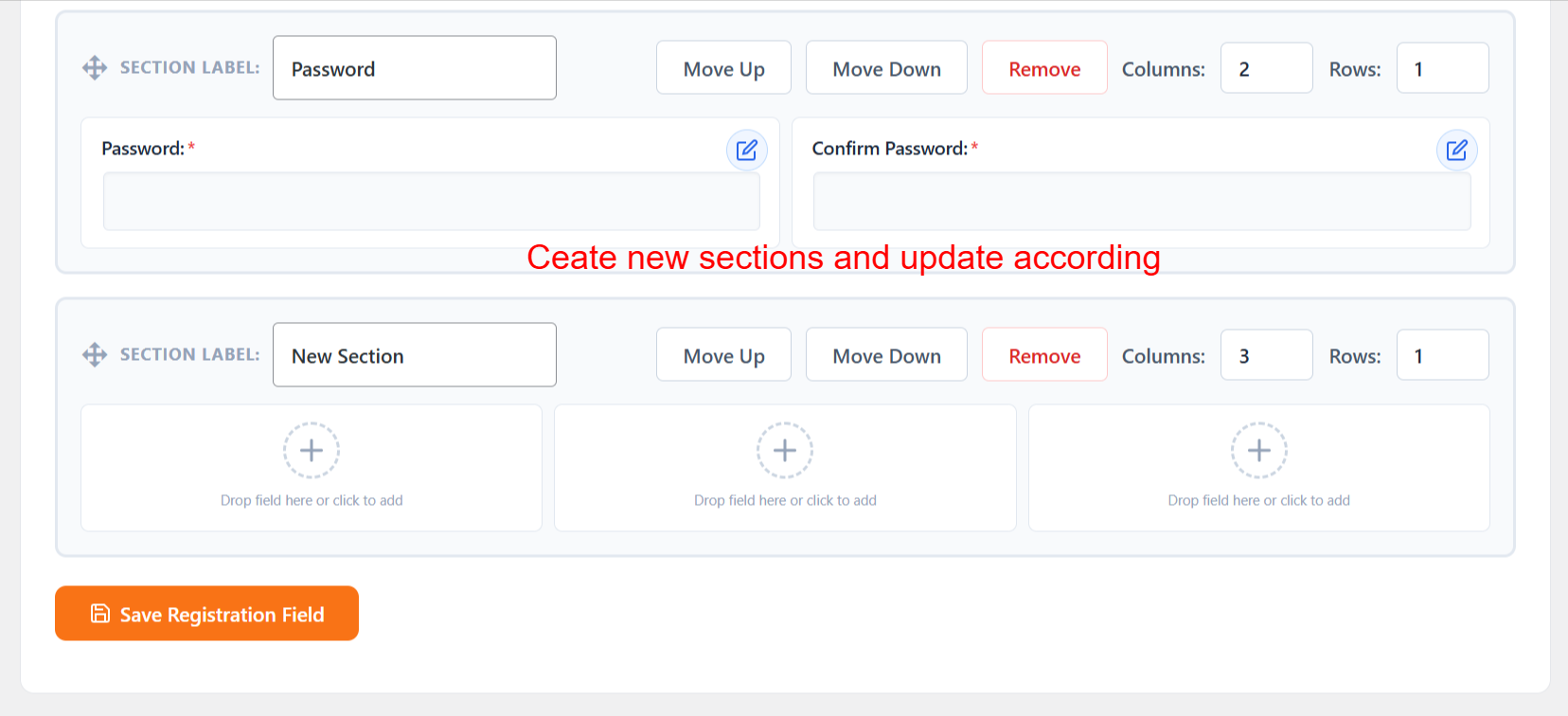
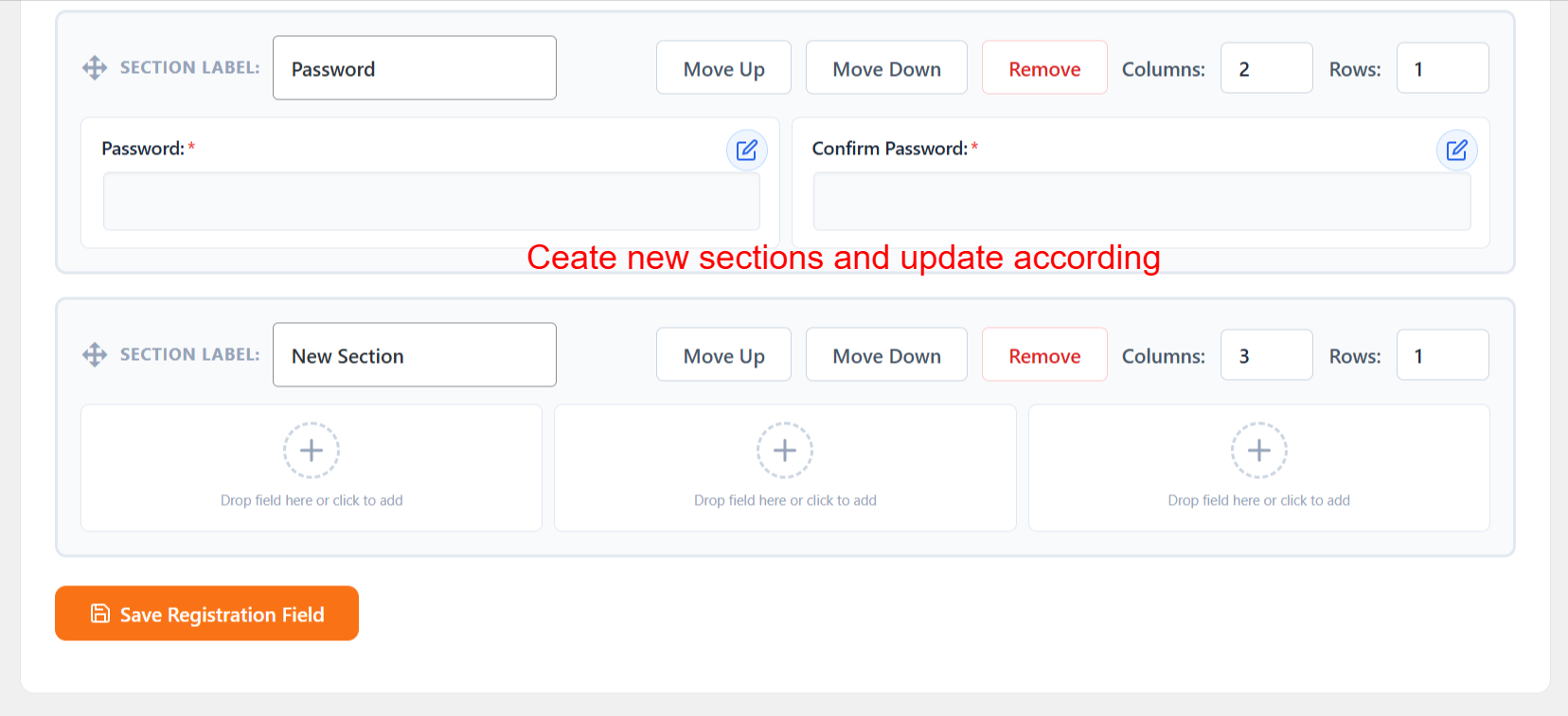
Here, users can add new sections to the registration form, allowing further customization. The interface supports moving sections, adding new fields, and deleting unwanted sections, creating a flexible registration form tailored to varying user requirements.
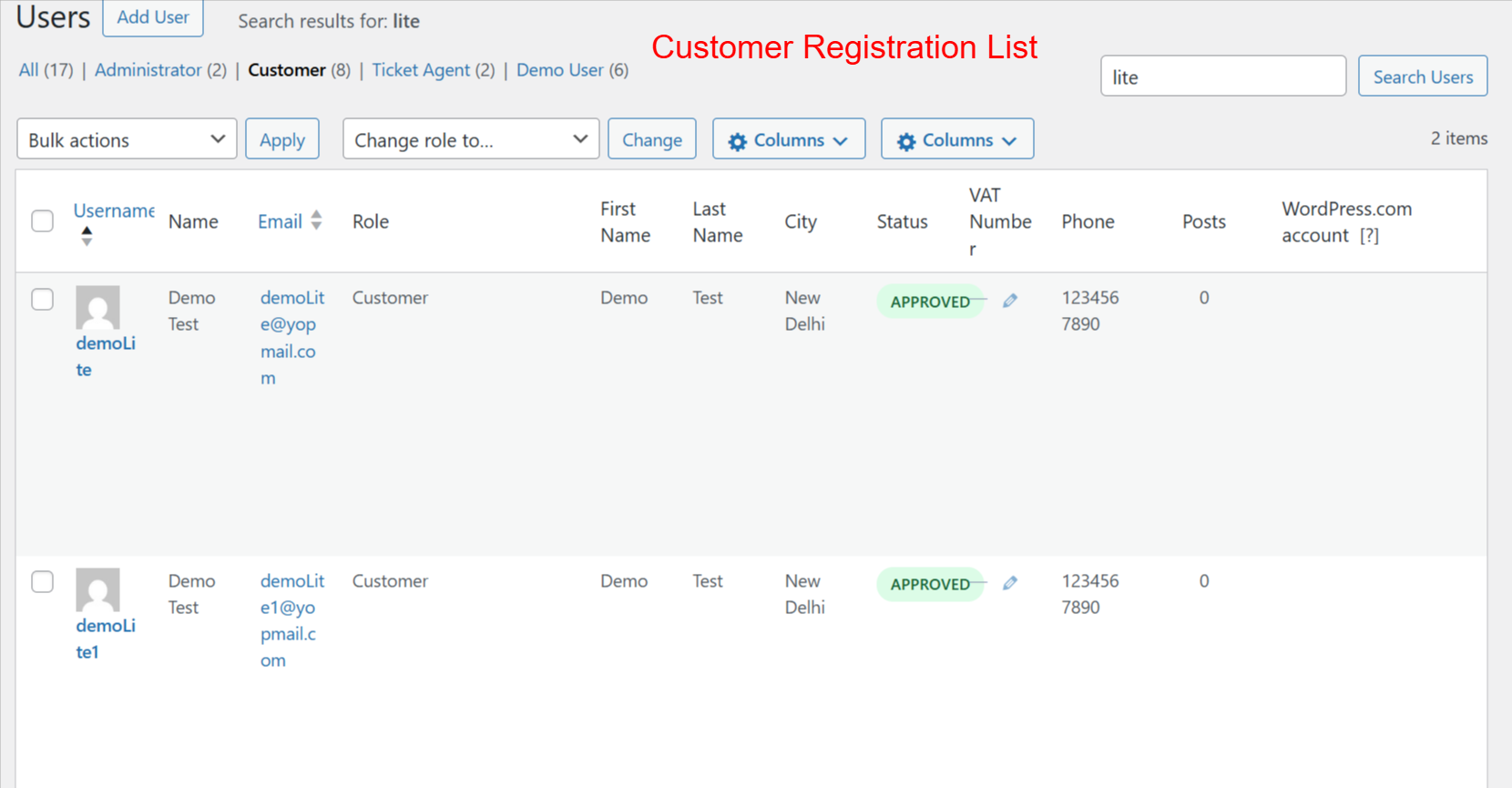
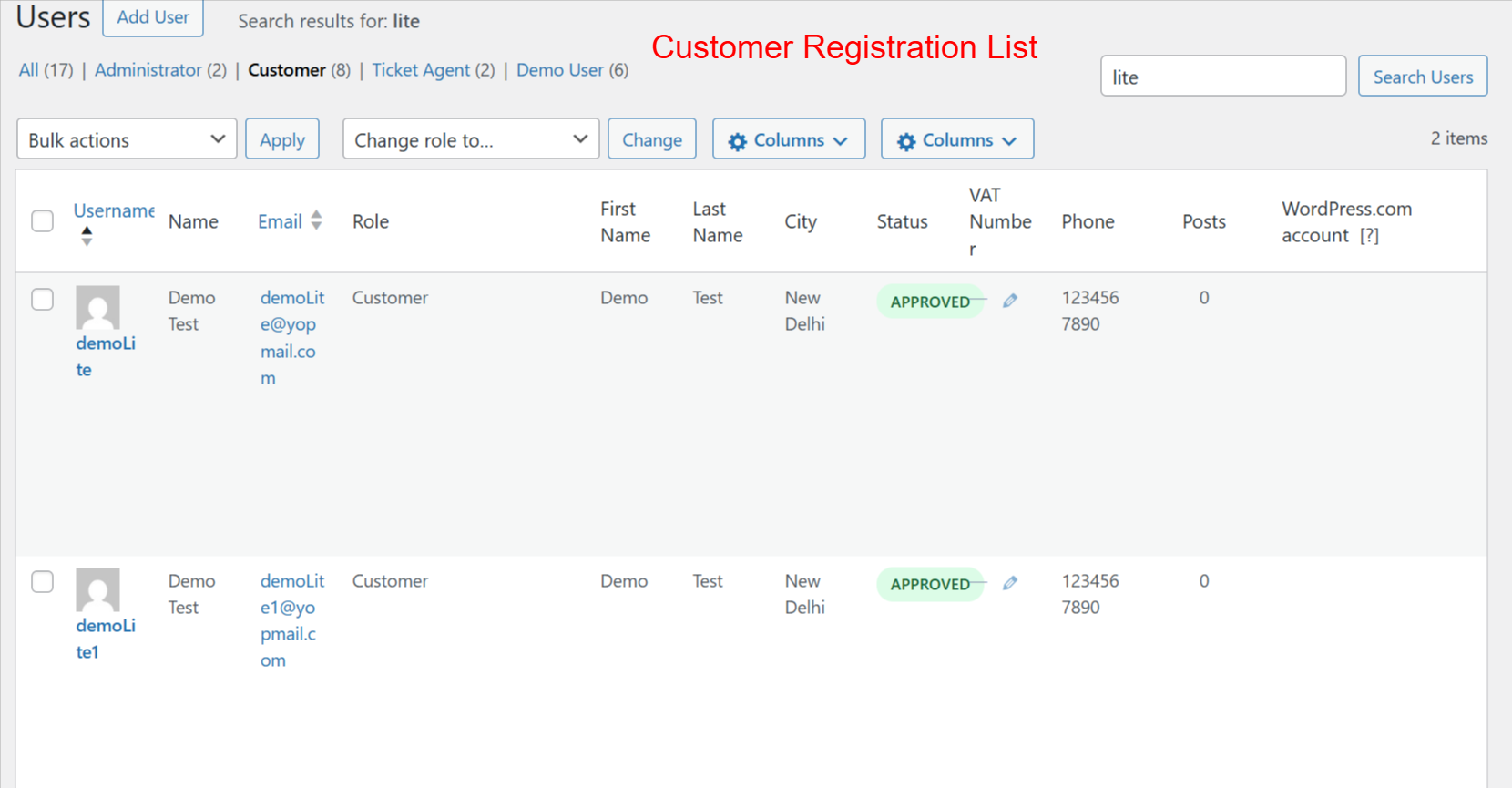
Admins use this screen to manage user accounts effectively. It provides insights into user roles, status, and personal details, enabling quick edits and status updates. This functionality is crucial for maintaining a clean and organized user database, especially in a WooCommerce environment.
Data Management
Ensure accuracy and manageability of collected user data.
- Store user meta data securely
- Reflect registration inputs in user list
- Overview of saved user fields
- Editable custom user fields
- Tools for user data auditing
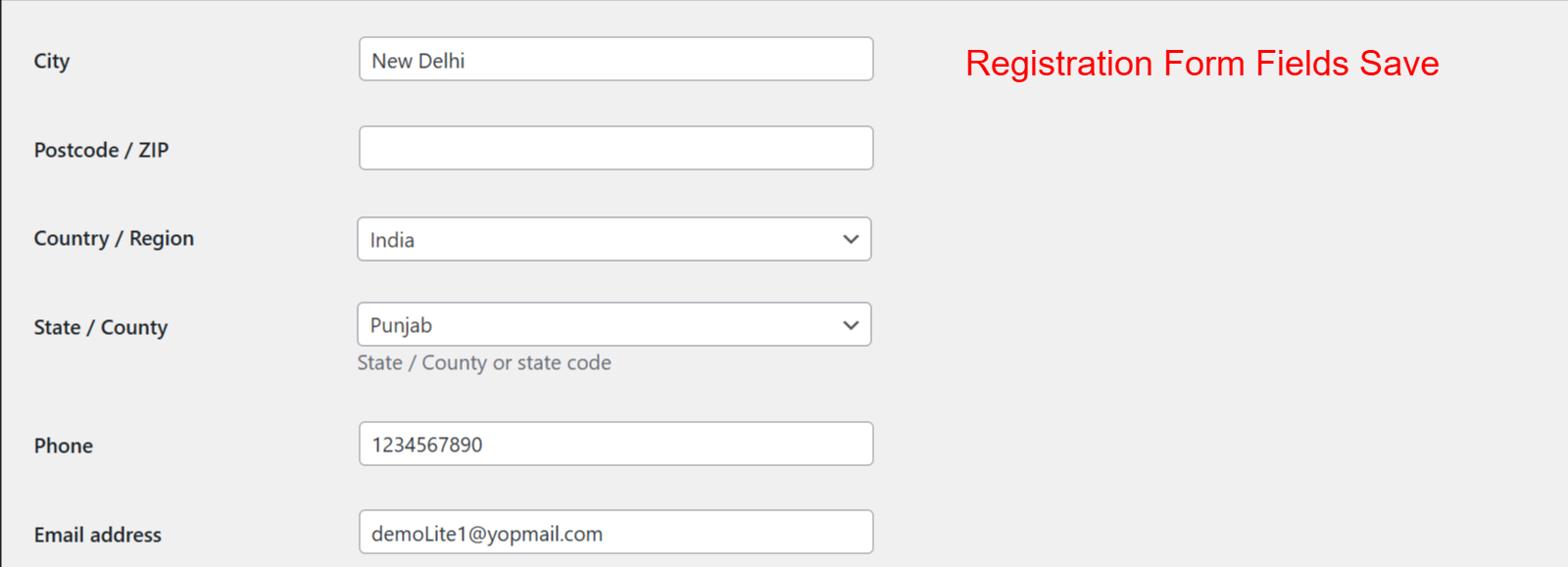
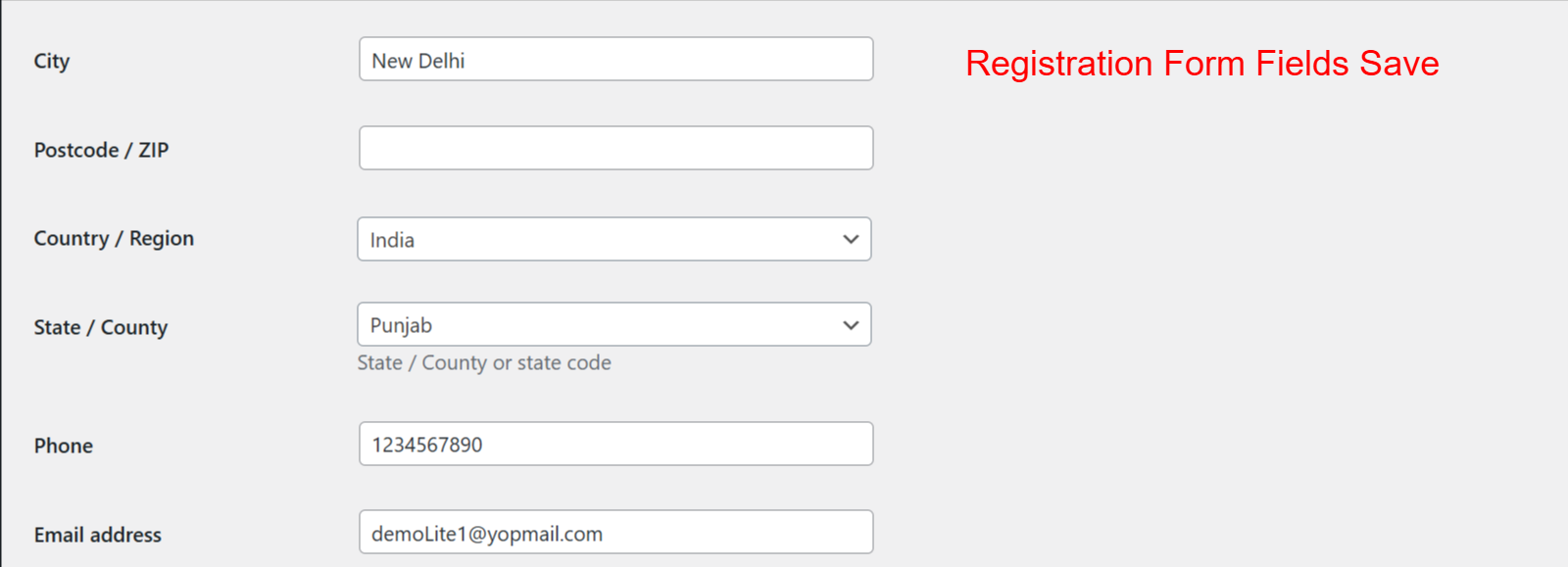
Once registered, user details are saved and viewable here. This screen allows admins to review saved user data, facilitating better understanding and management of registrations. It's integral for verifying user information and ensuring accuracy within the WooCommerce system.
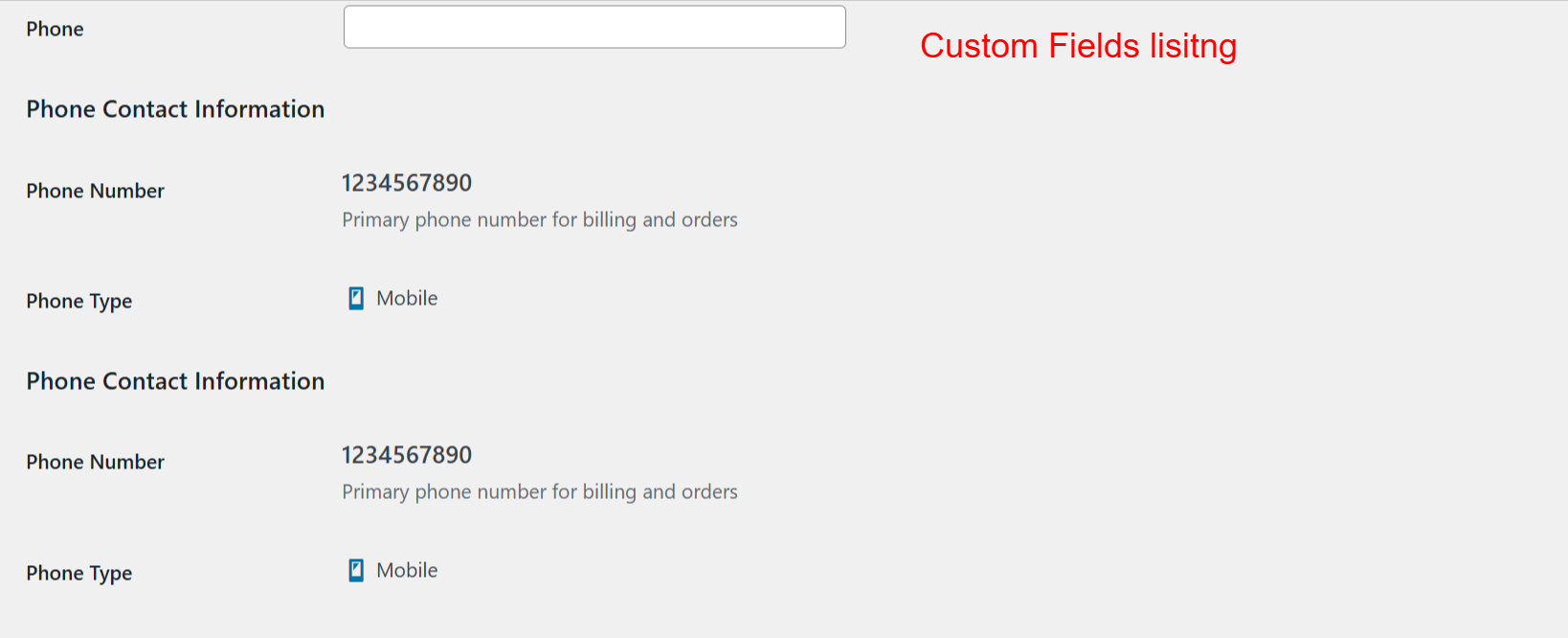
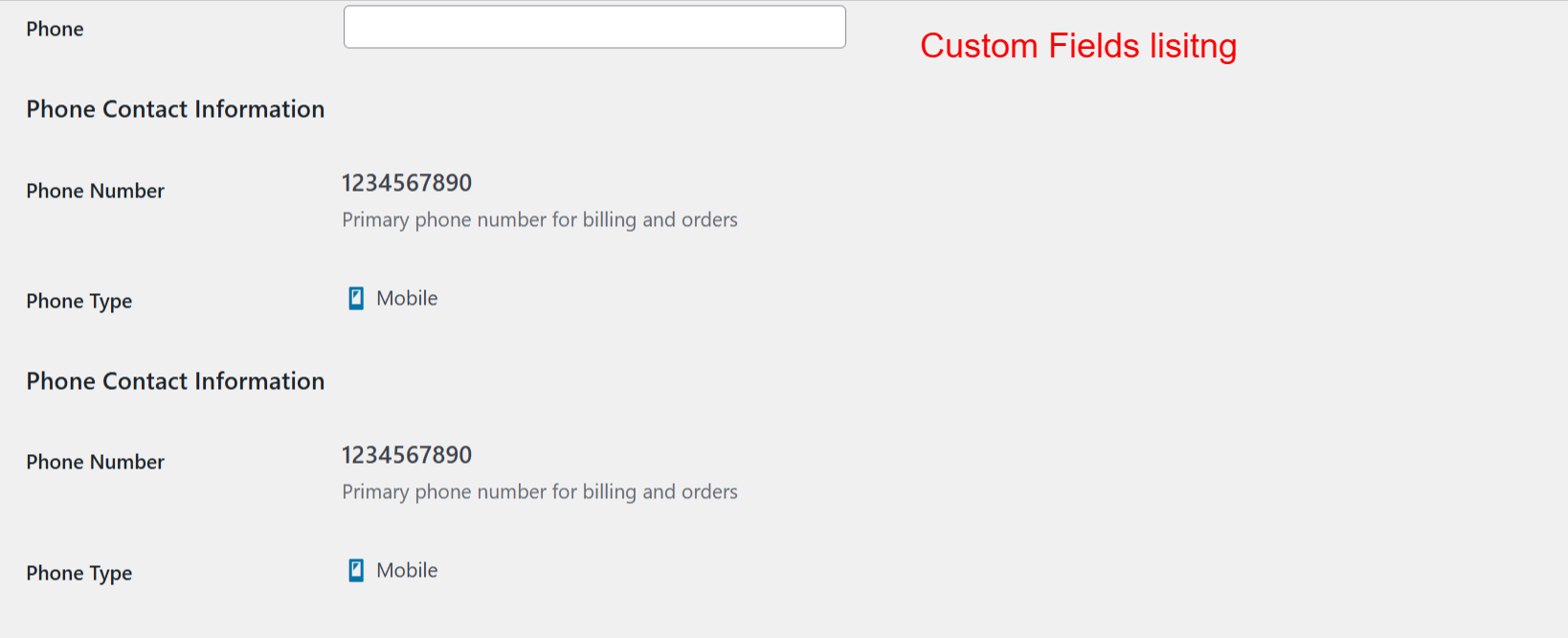
Custom fields shown here enrich user profiles with detailed contact information. Admins utilize this screen to view or edit custom fields that users have filled out during registration, enhancing personalized communication and service. This is vital for businesses leveraging custom data in WooCommerce.
3 Configuration Walkthrough
Activate the Plugin
Navigate to Plugins in your WordPress dashboard. Locate Registration Field Suite Lite and click Activate to enable the plugin. This step is crucial for incorporating custom fields into your WooCommerce registration form.
On this screen, you can activate the Registration Field Suite Lite plugin, which is essential for extending the functionality of WooCommerce registration forms. Activating the plugin enables you to add custom fields to the default WooCommerce registration form without needing additional customization.
Access Registration Field Suite
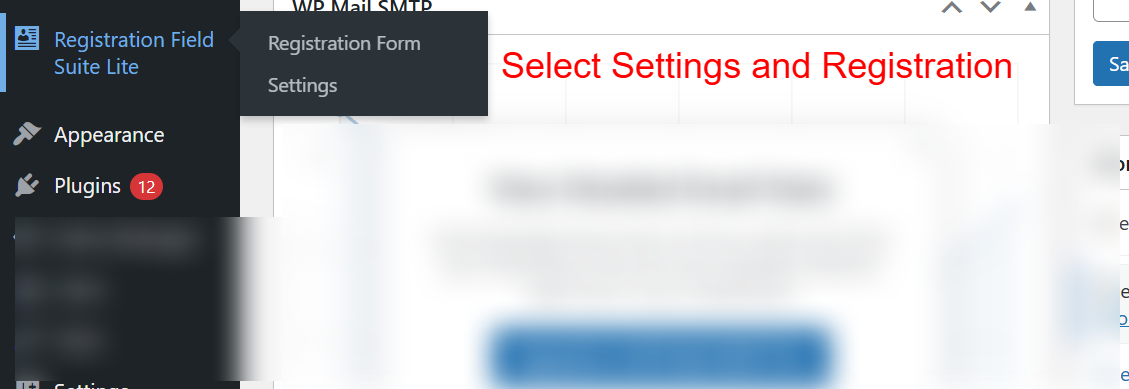
Once activated, find Registration Field Suite in the admin sidebar menu. Selecting this will open the form editor directly, ready for customization.
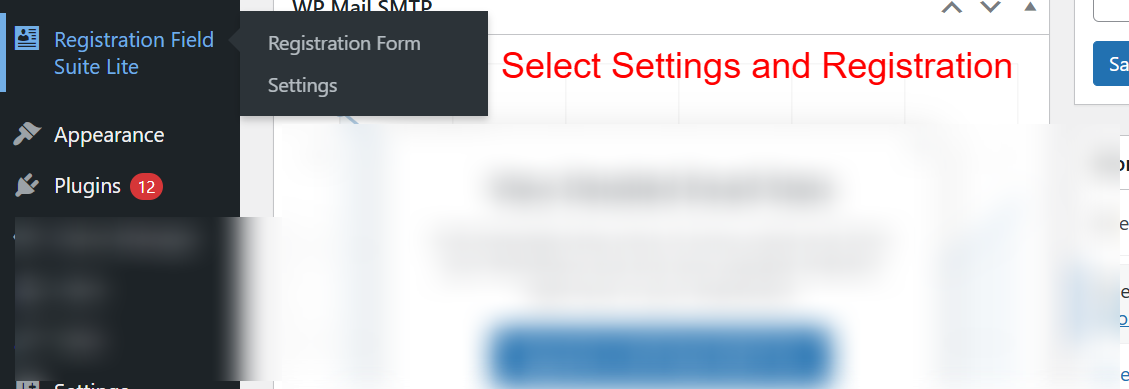
In this area of the WordPress admin dashboard, you can access the key features of the Registration Field Suite Lite plugin. You can navigate to 'Registration Form' to manage custom fields or to 'Settings' for configuring the plugin's operational parameters.
Create or Edit Registration Form
Use the drag-and-drop builder to create or modify your registration form. Add fields by dragging them from the widget panel, then configure each one for the information you wish to collect from users.
This screen is where you can design and customize the registration forms for your WooCommerce store. You can add new fields, arrange them in sections, and define how they display to users on the registration page, making it easier to collect necessary customer information.
Field Configuration
Select a field to configure its settings in the modal. Here you can set the Field Type, Label, Required status, and any Validation needed for the field, such as Email or Number.
On this screen, select the type of input field you want to add to your registration form. Options include input boxes, checkboxes, radio buttons, and more, allowing you to gather specific data types from registrants.
Here, choose from a list of default fields related to customer details, such as Name Prefix or Billing Information. This makes setting up comprehensive registration forms quick and straightforward.
Set Field Validations
Apply validations such as Required, Email, or Date to ensure accurate data entry. This reduces errors and improves data quality.
This part of the configuration allows you to apply validation rules to your form fields, ensuring that the data entered by users complies with specific criteria, such as format or type, enhancing form reliability and data accuracy.
Organize Form Layout
Use the drag-and-drop feature to organize fields into sections, arranging them using the grid options for visually clear layouts that fit your form's design.
In this configuration screen, you can customize the WooCommerce registration form by dragging and dropping fields within sections. Each section features controls to move or delete fields, making it easy to tailor the form to your specific needs.
Save Changes
After configuring your fields, click Save Registration Field to update and publish your form changes, ensuring they reflect immediately on the frontend.
This screen confirms that the changes made to the registration form have been saved and are live on the frontend. It shows the entire form structure, including newly added sections and edited fields, ensuring users have full control over the form's layout.
Create Additional Sections
For more detailed forms, create new sections by clicking Create New Section. Tailor these sections to specific kinds of information you wish to gather.
Here, users can add new sections to the registration form, allowing further customization. The interface supports moving sections, adding new fields, and deleting unwanted sections, creating a flexible registration form tailored to varying user requirements.
Review Settings
Go to Settings under the Registration Field Suite to manage overall plugin features, enabling or disabling fields site-wide as needed.
This settings page allows you to enable or disable the Registration Field Suite Lite plugin's custom fields across your site. Choosing 'Yes' ensures that the custom fields are visible and functional on your WooCommerce registration forms.
4 User Journey
Access Registration Form
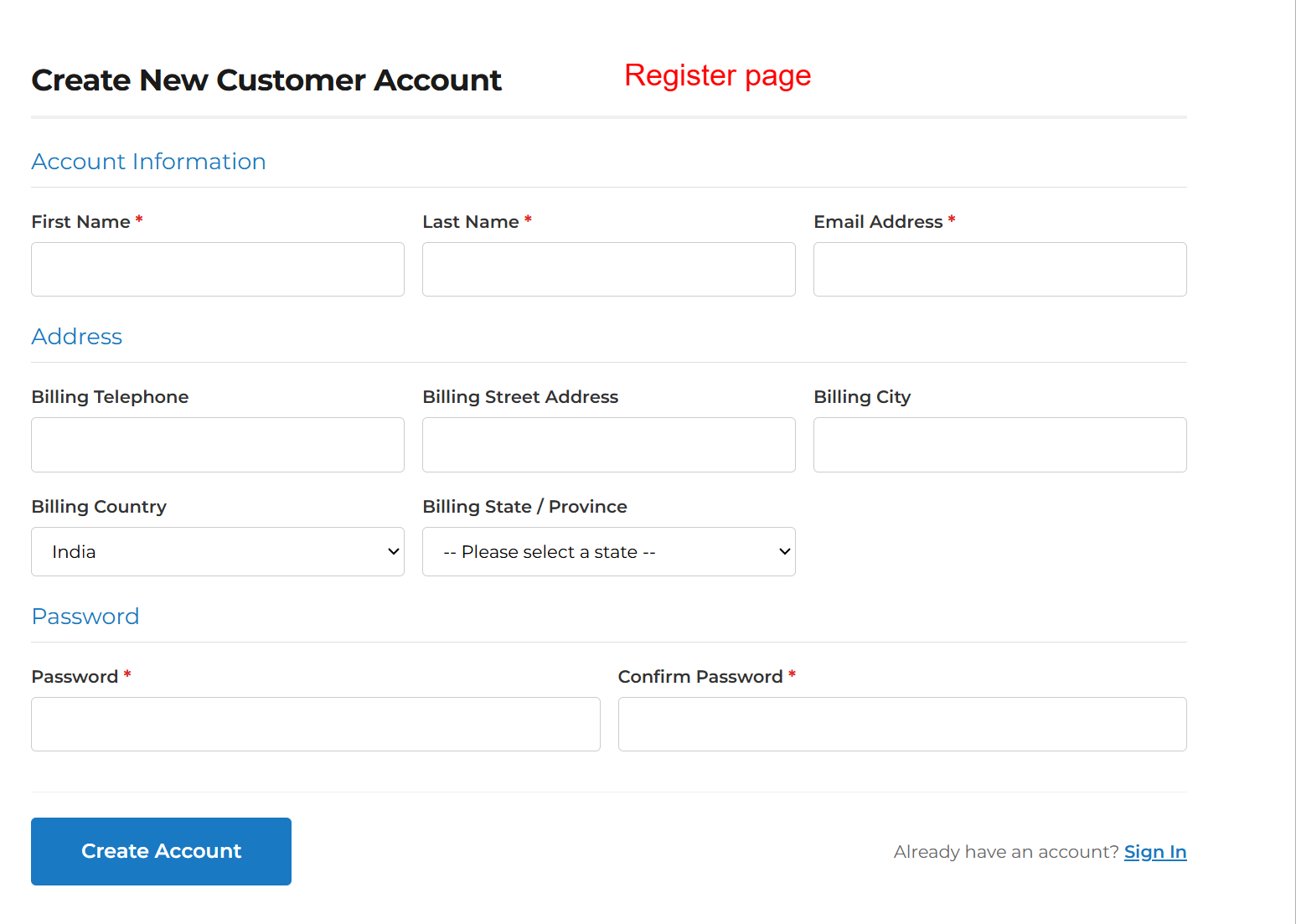
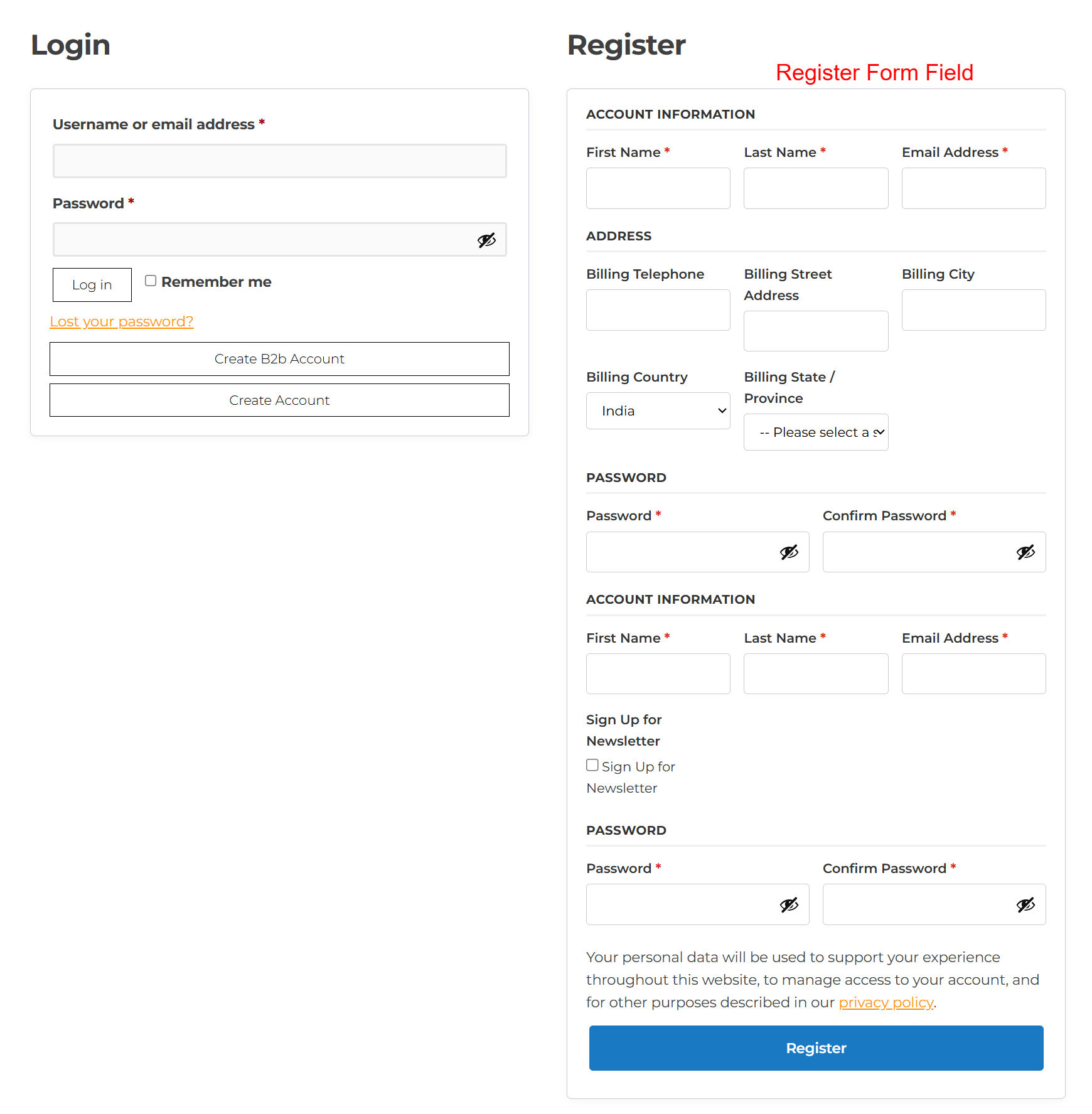
Customers visit the WooCommerce My Account page to find the registration form. Here, they can seamlessly start their registration process as fields are tailored to capture essential information efficiently.
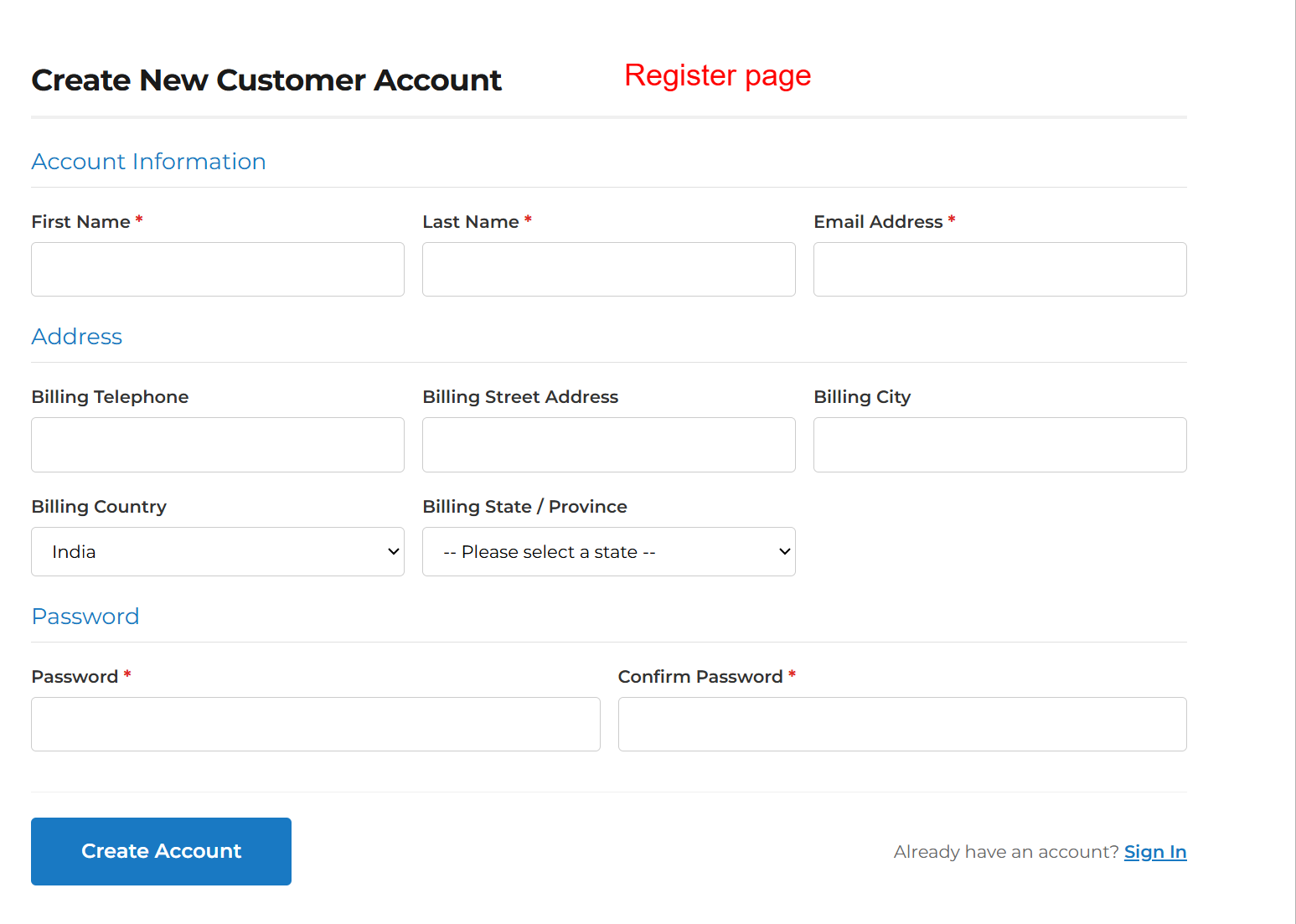
This is how the registration page appears to visitors. It captures essential information through the customized fields set up in the admin area. Providing a user-friendly registration process, it encourages account creation and enhances user engagement.
Complete Registration
Users fill out the mandatory and optional fields in the registration form, confirmed with client-side validation to ensure data accuracy and completeness.
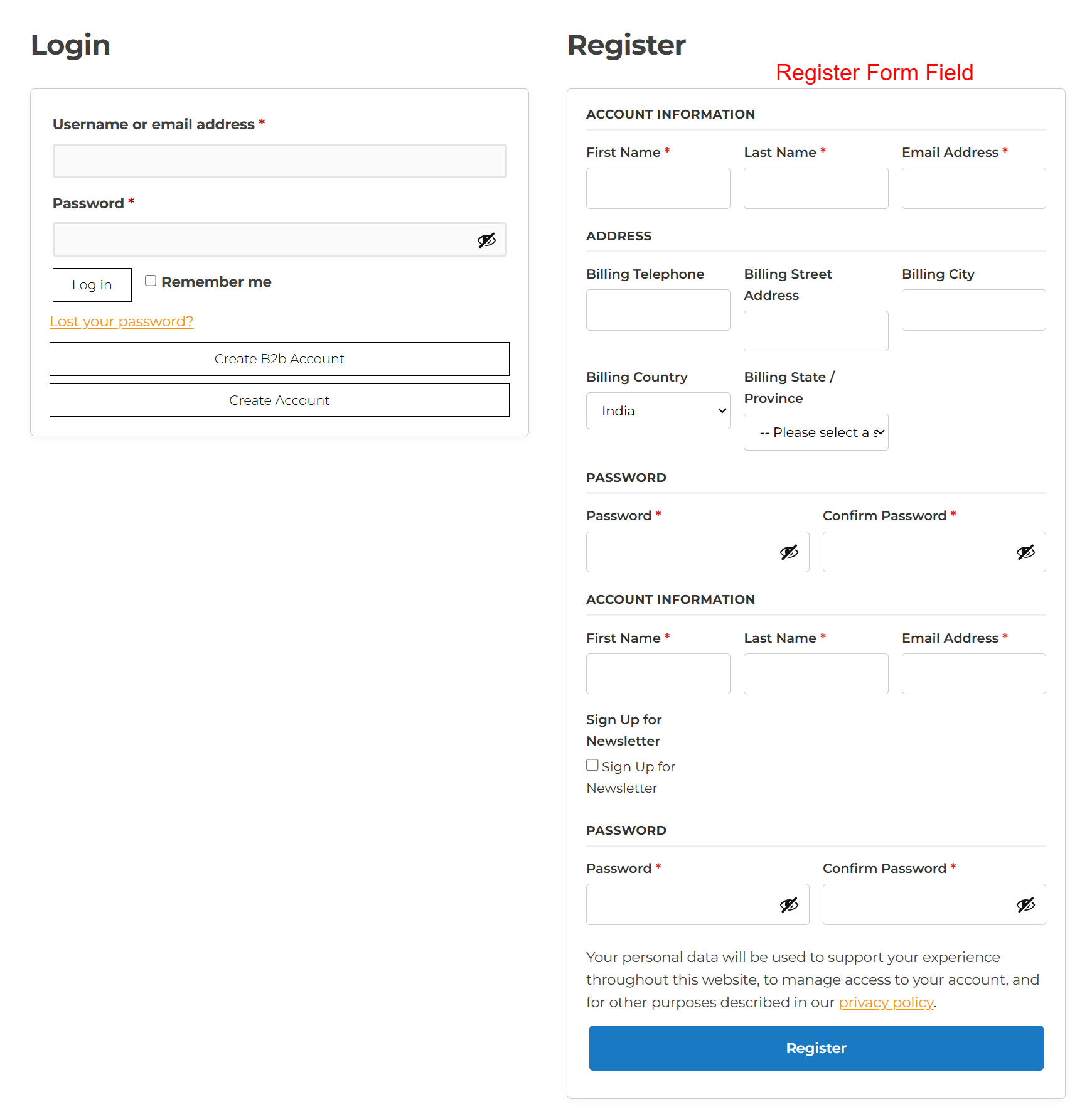
This page is pivotal for new users who want to register for an account and existing users logging in. The registration form extends default WooCommerce fields by enabling fields for personal and billing information. Users can create an account or log in with ease, making this screen essential for user onboarding.
User Dashboard Access
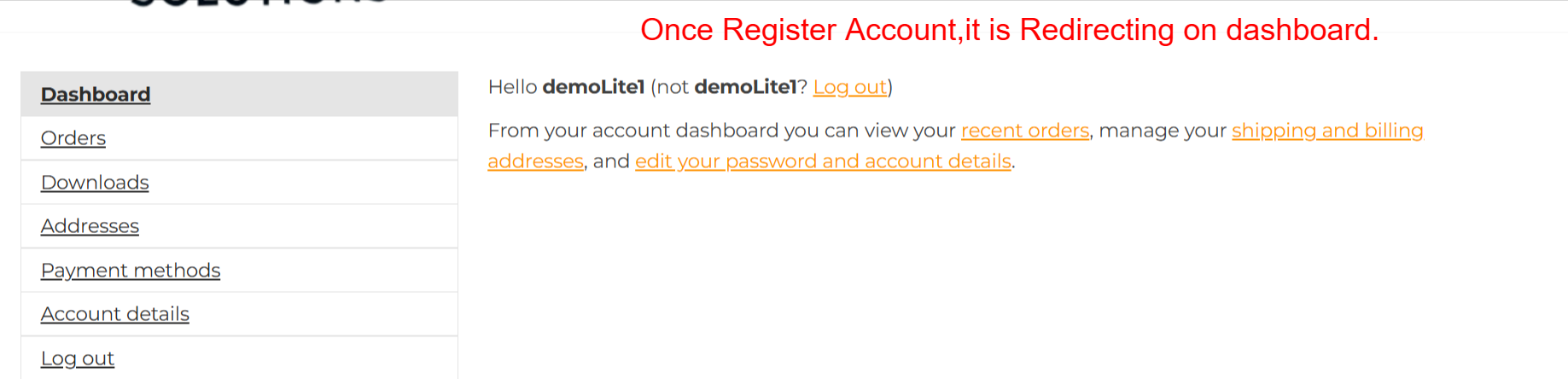
Upon successful registration, users gain access to the dashboard where they manage personal settings, view orders, and edit account info, underscoring their control over the shopping journey.
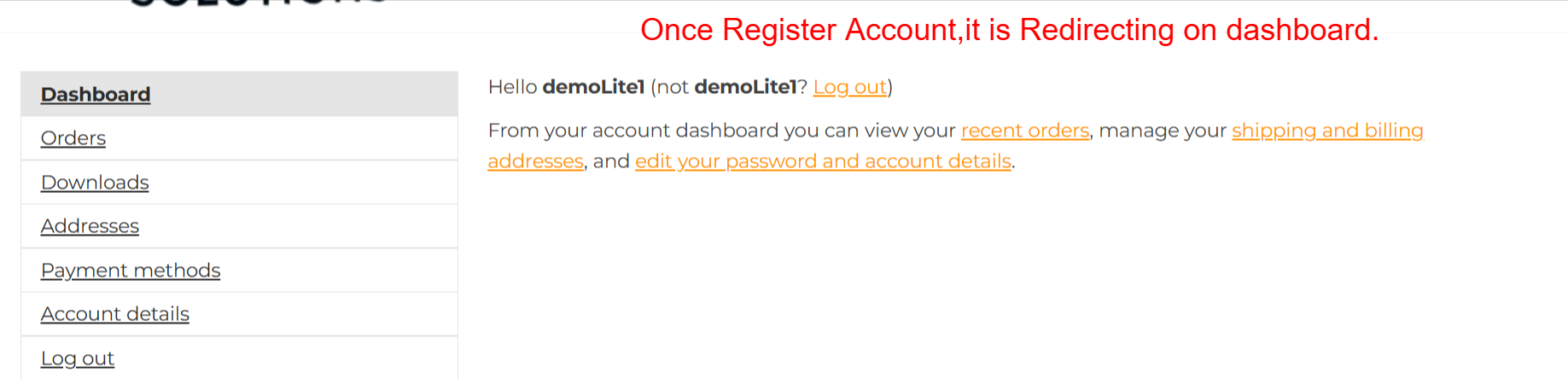
Upon successful registration, users are redirected to the dashboard where they can manage various account details such as viewing orders, managing addresses, and editing account settings. This centralized hub empowers users to have greater control over their shopping experience.
Manage Billing Information
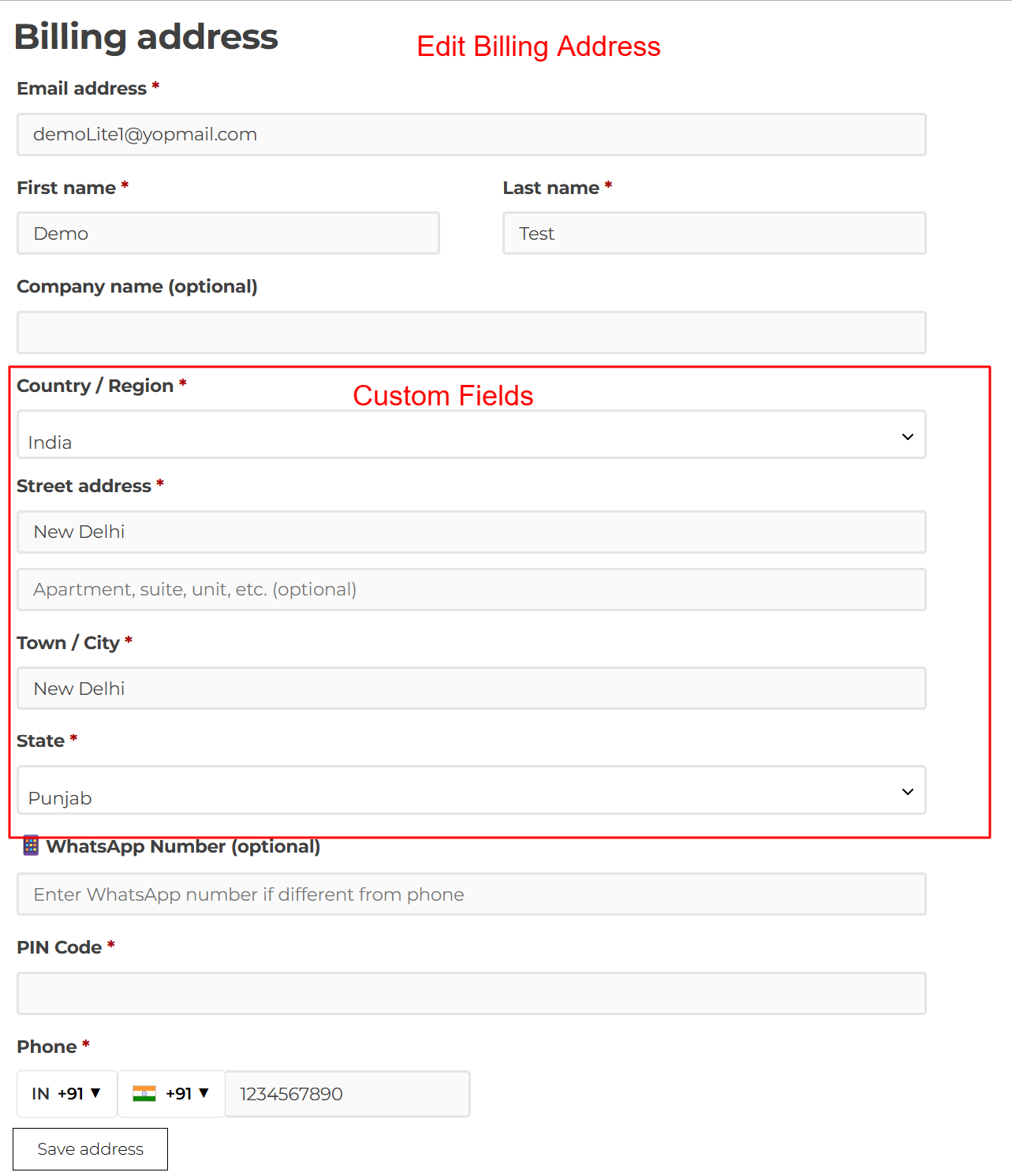
Users can easily update their billing information by navigating to the Billing Address section. The changes reflect immediately, ensuring online transactions proceed smoothly.

This section of the user dashboard shows the current billing address with an option to edit it. Providing users with easy access to update their billing information helps ensure transactions are smooth and addresses remain accurate.
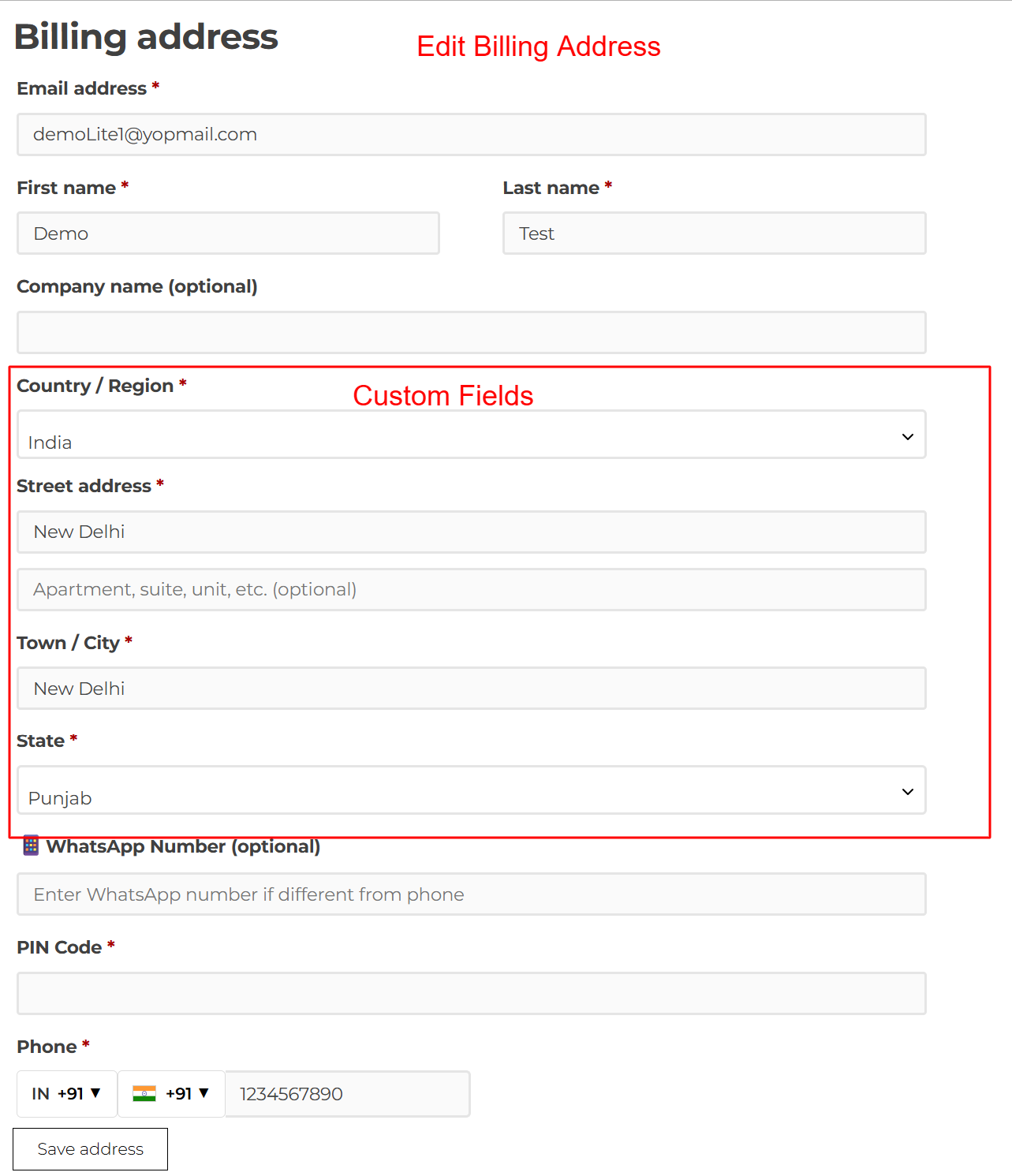
On this screen, users can update their billing address by filling in the relevant fields. This interface makes it straightforward to alter personal information, ensuring the user can quickly adapt their details to suit any changes in status or location.
5 Use Cases
Single-store Simple Registration
An online store uses Registration Field Suite Lite to add a few extra registration fields to capture customer preferences without the need for complex multi-form setups.
Extend Customer Profiles
A store owner enriches customer profiles by adding additional fields like birthday and phone number, collecting personalized data useful for marketing strategies.
Testing Custom Fields
Before committing to the Pro version, the development team tests custom fields in the Lite version to understand field customization options and data integration.
Seasonal Shop Adjustments
A shop selling seasonal goods updates its registration forms quarterly using the Lite version, facilitating product launches without a heavy data setup.
7 Shortcodes
| Shortcode | File |
|---|---|
[eweb_regist_lite_account] |
includes/frontend/class-frontend.php |
[eweb_regist_lite_captcha] |
includes/frontend/class-frontend.php |
[eweb_regist_lite_confirmation] |
includes/frontend/class-frontend.php |
[eweb_regist_lite_create] |
includes/frontend/class-frontend.php |
[eweb_regist_lite_createpost] |
includes/frontend/class-frontend.php |
[eweb_regist_lite_download] |
includes/frontend/class-frontend.php |
[eweb_regist_lite_edit] |
includes/frontend/class-frontend.php |
[eweb_regist_lite_editpost] |
includes/frontend/class-frontend.php |
[eweb_regist_lite_alikon] |
includes/frontend/class-frontend.php |
[eweb_regist_lite_captchaform] |
includes/frontend/class-frontend.php |
[eweb_regist_lite_securimage] |
includes/frontend/class-frontend.php |
[eweb_regist_lite_confirm] |
includes/frontend/class-frontend.php |
[eweb_regist_lite_alikon] |
includes/frontend/class-frontend.php |
[eweb_regist_lite_captchaform] |
includes/frontend/class-frontend.php |
[eweb_regist_lite_securimage] |
includes/frontend/class-frontend.php |
[eweb_regist_lite_uploadfile] |
includes/frontend/class-frontend.php |
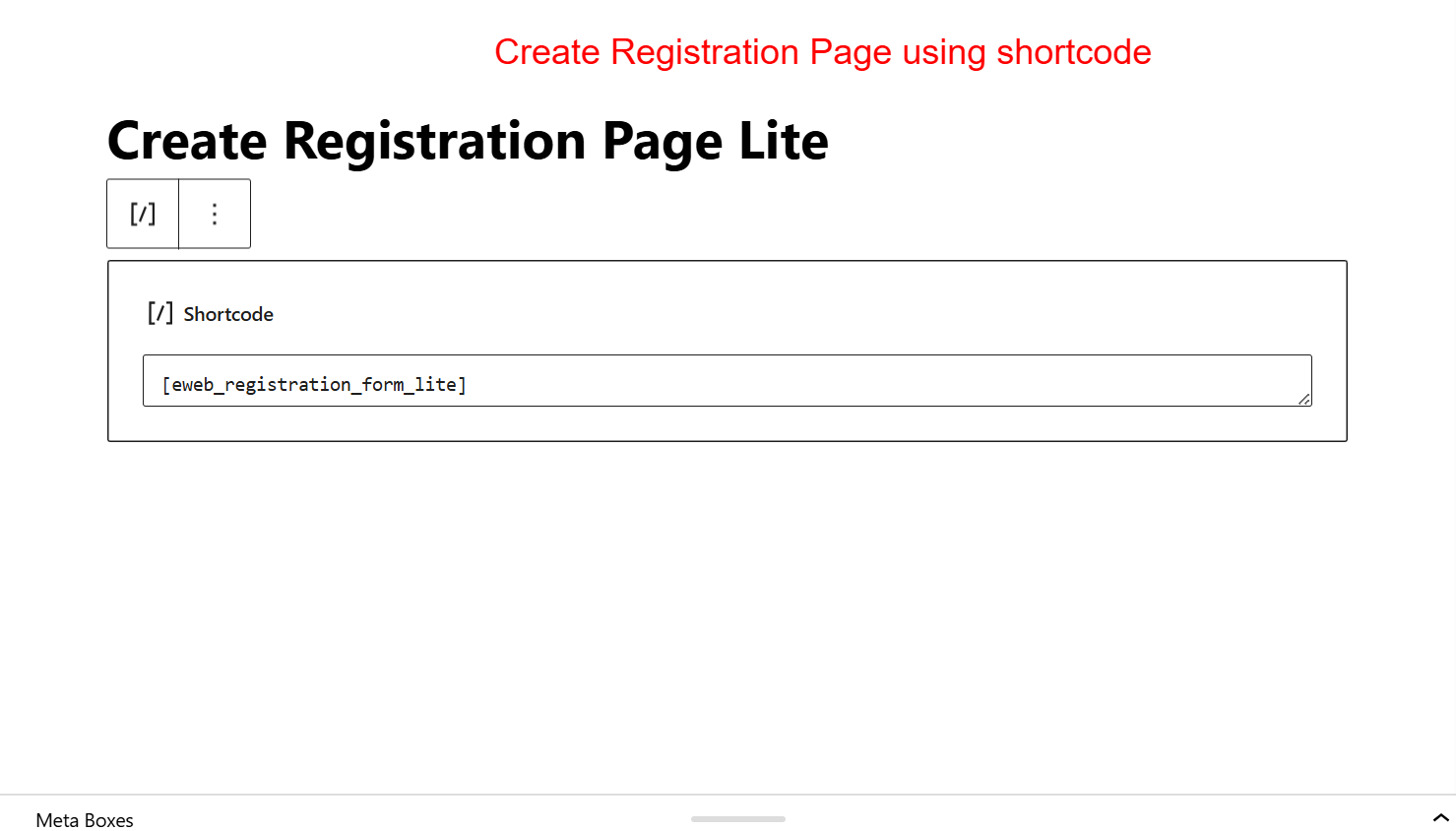
[eweb_registration_form_lite] |
includes/hooks/class-hooks.php |
9 Tips & Tricks
- Regularly review user data for insights to improve sales.
- Start with essential fields to increase form completion rates.
- Prefill fields with user data for better user experience.
- Utilize sections to logically group related fields.
- Evaluate if upgrading to Pro meets business needs for extra features.
- Check documentation for form validation options.
- Keep plugin updated for latest security and feature enhancements.
10 Changelog
1.0.0
- Initial release of the Lite edition.
- Drag-and-drop form builder limited to the single default WooCommerce registration form.
- 9 field types: Text, Password, Checkbox, Radio, Select, List Box, Multi-select List Box, Textarea, Date.
- Per-field built-in validators (Email, Name, Number, Money, Phone, Date, Zip code).
- WooCommerce registration form integration and My Account → Account Details rendering.
- HPOS and Cart/Checkout Blocks compatibility declared.
- Separate namespace from the Pro plugin so both can be active simultaneously.
11 Step-by-Step Screenshot Reference
Every captured screen in setup order. Click any image to open the full-size version in a new tab.
wp-admin: Plugin Activation List
What this shows: This interface shows the installed plugins list in the WordPress admin panel. It displays the Registration Field Suite Lite plugin with options to 'Deactivate' or 'Check this plugin'. The plugin's description is also visible.
On this screen, you can activate the Registration Field Suite Lite plugin, which is essential for extending the functionality of WooCommerce registration forms. Activating the plugin enables you to add custom fields to the default WooCommerce registration form without needing additional customization.
wp-admin: Select Settings and Registration
What this shows: The screenshot shows a dropdown menu under 'Registration Field Suite Lite' in the WordPress admin sidebar, with options for 'Registration Form' and 'Settings'.
In this area of the WordPress admin dashboard, you can access the key features of the Registration Field Suite Lite plugin. You can navigate to 'Registration Form' to manage custom fields or to 'Settings' for configuring the plugin's operational parameters.
Create New Registrations Form Interface
What this shows: This interface allows you to create or edit a WooCommerce registration form, displaying field configurations, section labels, and options to add or remove fields.
This screen is where you can design and customize the registration forms for your WooCommerce store. You can add new fields, arrange them in sections, and define how they display to users on the registration page, making it easier to collect necessary customer information.
Field Configurations Modal
What this shows: A modal for configuring each form field, showing options like Field Type, Label, Required, Validation, Default Value, CSS Class, and HTML Arguments.
Within the field configuration modal, you can fine-tune the details of each custom field you add to your registration form. Define whether a field is mandatory, its input type, validation rules, and additional HTML for enhanced design and functionality.
General Settings: Enable Plugin Features
What this shows: Settings page of the plugin displaying a dropdown to enable or disable registration fields with a 'Save Changes' button.
This settings page allows you to enable or disable the Registration Field Suite Lite plugin's custom fields across your site. Choosing 'Yes' ensures that the custom fields are visible and functional on your WooCommerce registration forms.
Set Default Field Type
What this shows: Field configuration screen showing a dropdown menu with various field types like Input Box, Password, Checkbox(es), and others.
On this screen, select the type of input field you want to add to your registration form. Options include input boxes, checkboxes, radio buttons, and more, allowing you to gather specific data types from registrants.
Choose Default Fields
What this shows: Field configuration interface with a dropdown to select default fields like Name Prefix, Gender, Billing Address, etc.
Here, choose from a list of default fields related to customer details, such as Name Prefix or Billing Information. This makes setting up comprehensive registration forms quick and straightforward.
Form Field Validations Selection
What this shows: Field configuration panel displaying a dropdown for choosing validation types like Email, Name, Number, Phone, etc.
This part of the configuration allows you to apply validation rules to your form fields, ensuring that the data entered by users complies with specific criteria, such as format or type, enhancing form reliability and data accuracy.
wp-admin: Form Configuration > Drag and Drop
What this shows: This screen lets you arrange 'Account Information' and 'Password' fields using drag-and-drop. It has options to move sections up/down or remove them.
In this configuration screen, you can customize the WooCommerce registration form by dragging and dropping fields within sections. Each section features controls to move or delete fields, making it easy to tailor the form to your specific needs.
wp-admin: Form Configuration > Save Confirmation
What this shows: Displays a confirmation message that the registration form was saved, showing sections such as 'Account Information', 'Address', and 'Password'. The 'Save Registration Field' button is visible.
This screen confirms that the changes made to the registration form have been saved and are live on the frontend. It shows the entire form structure, including newly added sections and edited fields, ensuring users have full control over the form's layout.
wp-admin: Form Configuration > Create New Section
What this shows: Shows the 'Password' and 'New Section' areas with options to add fields or remove sections. The 'Save Registration Field' button is also visible.
Here, users can add new sections to the registration form, allowing further customization. The interface supports moving sections, adding new fields, and deleting unwanted sections, creating a flexible registration form tailored to varying user requirements.
wp-admin: Create Registration Page Using Shortcode
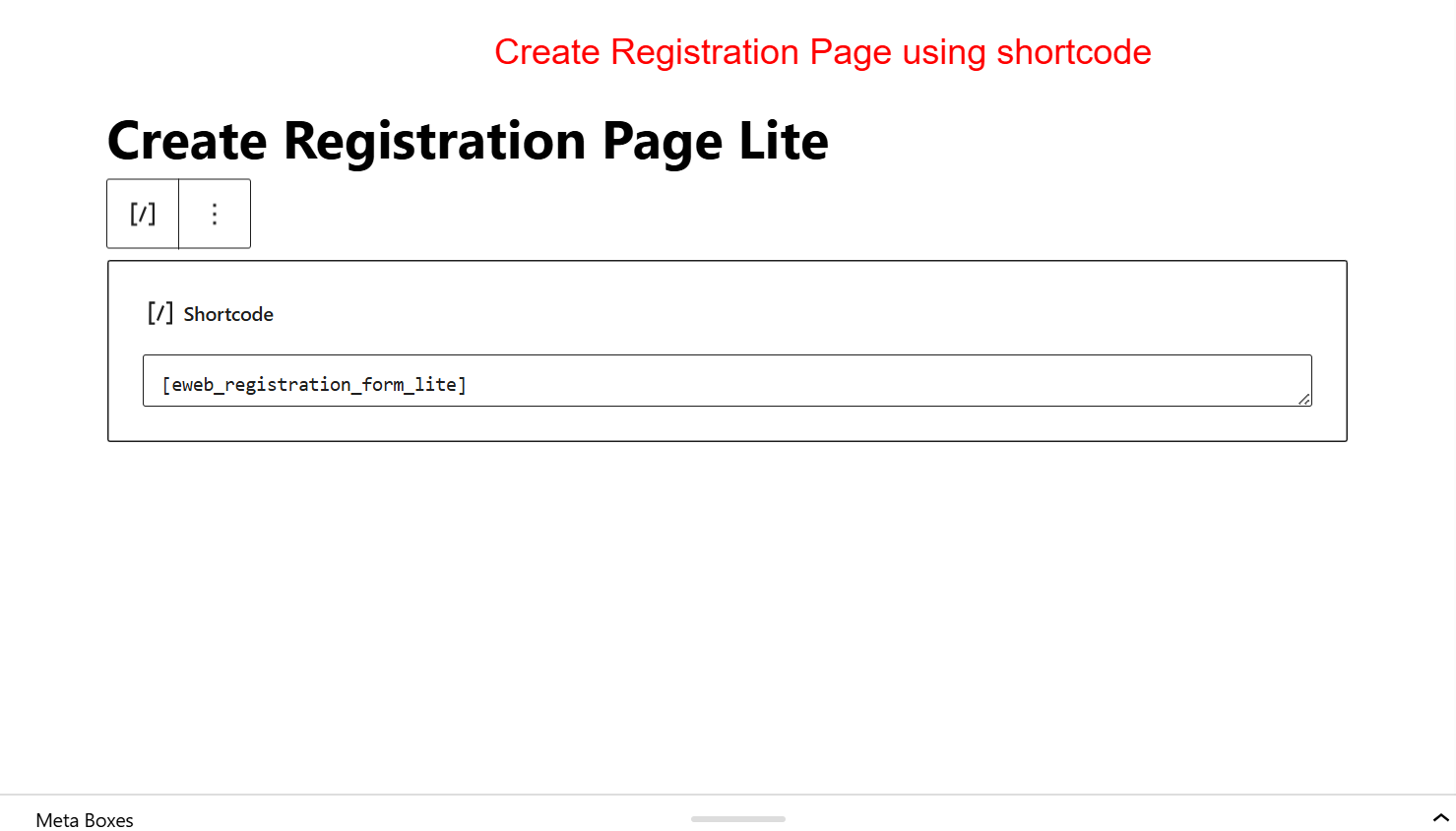
What this shows: Contains a shortcode editor where '[eweb_registration_form_lite]' is displayed to create the registration page.
This screen guides users in creating a registration page using a shortcode. By embedding the provided shortcode into a page, users can effortlessly display the custom-built registration form on their site, making it accessible to visitors.
Frontend: Customer Registration Page
What this shows: The registration page includes sections for 'Account Information', 'Address', and 'Password' with fields like 'First Name', 'Billing Telephone', and 'Password'.
This is how the registration page appears to visitors. It captures essential information through the customized fields set up in the admin area. Providing a user-friendly registration process, it encourages account creation and enhances user engagement.
Frontend: User Dashboard Overview
What this shows: The dashboard includes navigation options for 'Orders', 'Downloads', 'Addresses', etc. It welcomes the user and provides account management links.
Upon successful registration, users are redirected to the dashboard where they can manage various account details such as viewing orders, managing addresses, and editing account settings. This centralized hub empowers users to have greater control over their shopping experience.
Frontend: User Dashboard - Billing Address
What this shows: Displays the billing address details with an 'Edit Billing address' link available.
This section of the user dashboard shows the current billing address with an option to edit it. Providing users with easy access to update their billing information helps ensure transactions are smooth and addresses remain accurate.
Frontend: Edit Billing Address
What this shows: Contains fields to edit billing details such as 'Email address', 'First name', 'Country/Region', etc.
On this screen, users can update their billing address by filling in the relevant fields. This interface makes it straightforward to alter personal information, ensuring the user can quickly adapt their details to suit any changes in status or location.
Registration and Login Page Interface
What this shows: The interface displays login fields for 'Username or email address' and 'Password', as well as registration fields like 'First Name', 'Last Name', and 'Email Address'. Options for 'Billing Information' and newsletter signup are also visible.
This page is pivotal for new users who want to register for an account and existing users logging in. The registration form extends default WooCommerce fields by enabling fields for personal and billing information. Users can create an account or log in with ease, making this screen essential for user onboarding.
Admin Dashboard: User List Overview
What this shows: This screen lists users with columns for 'Username', 'Name', 'Email', 'Role', 'City', 'Status', and other details. Options for bulk actions and filtering by role are available.
Admins use this screen to manage user accounts effectively. It provides insights into user roles, status, and personal details, enabling quick edits and status updates. This functionality is crucial for maintaining a clean and organized user database, especially in a WooCommerce environment.
User Fields: Registration Data Saved
What this shows: Fields such as 'City', 'Postcode', 'Country', 'State', 'Phone', and 'Email Address' are displayed, indicating saved registration data.
Once registered, user details are saved and viewable here. This screen allows admins to review saved user data, facilitating better understanding and management of registrations. It's integral for verifying user information and ensuring accuracy within the WooCommerce system.
User Custom Fields Listing
What this shows: It lists custom fields like 'Phone Number' and 'Phone Type', providing additional contact information.
Custom fields shown here enrich user profiles with detailed contact information. Admins utilize this screen to view or edit custom fields that users have filled out during registration, enhancing personalized communication and service. This is vital for businesses leveraging custom data in WooCommerce.




Reviews
There are no reviews yet.